
Key Takeaways Summary
- Highlight Mixology & Speed: Clearly distinguish between craft cocktail creation and high-volume speed bartending based on the venue type.
- Quantify Your Impact: Use numbers (e.g., “served 200+ guests nightly” or “increased bar sales by 15%”) to prove your value.
- Showcase POS Proficiency: Mention specific Point of Sale systems (Toast, Aloha, Square) to show you are ready to hit the ground running.
- Emphasize Soft Skills: Customer service, conflict resolution, and upselling are just as critical as making drinks in a bartender resume.
- Certifications Matter: Always list ServSafe, TIPS, or local alcohol safety certifications to demonstrate compliance and responsibility.
- ATS Optimization: Use relevant keywords like “inventory management,” “cash handling,” and “menu development” to pass scanning software.
Introduction
Creating a standout bartender resume requires more than just listing the cocktails you can mix. In the competitive hospitality industry of 2026, hiring managers are looking for professionals who can balance speed, accuracy, and exceptional customer service while driving revenue. Whether you are applying for a high-end mixology role or a high-volume nightclub gig, your resume serves as your first audition. 🍸
To ensure your application rises to the top of the pile, you need to structure your experience effectively. Here is how to make an impact:
- Tailor to the Venue: Customize your bartender resume description to match the specific vibe of the establishment—fine dining requires a different tone than a dive bar.
- Focus on Reliability: Bar managers prioritize dependability; highlight your attendance record and ability to handle closing duties.
- Showcase Versatility: Demonstrate your ability to handle everything from inventory checks to de-escalating unruly customers with grace.
📝 Create Bartender Resume AI

Luca Rossi
Professional Bartender • Miami, FL
Email: luca.rossi.bar@gmail.com • Phone: (305) 555-0199
Profile
Charismatic and efficient Bartender with 6+ years of experience in high-volume nightclubs and upscale cocktail lounges. Expert in craft mixology, inventory control, and driving sales through suggestive selling. Proven track record of maintaining 99% cash handling accuracy and elevating guest satisfaction scores.
Experience
Lead Bartender – The Azure Lounge, Miami Beach, FL (2021–Present)
• Crafted signature cocktail menu, increasing beverage revenue by 20% within the first year.
• Managed bar operations for a 200-seat venue, serving an average of 300+ guests per night.
• Trained 10+ junior staff members on recipes, POS systems (Toast), and responsible service standards.
• Conducted weekly inventory audits, reducing liquor waste by 15% through precise pouring techniques.
Bartender – Neon Nights Club, Miami, FL (2018–2021)
• Delivered high-speed service in a fast-paced nightclub environment, averaging 60 drinks per hour.
• Handled cash and credit transactions exceeding $5,000 nightly with zero discrepancies.
• Resolved customer complaints calmly and effectively, ensuring a safe and enjoyable atmosphere.
• Collaborated with security to enforce ID checks and prevent over-intoxication.
Education
Associate of Arts in Hospitality Management – Miami Dade College (2016–2018)
Skills
Mixology • POS Systems (Toast, Aloha) • Inventory Management • Customer Service • Cash Handling • Upselling • Speed Bartending • Conflict Resolution
Certificates
ServSafe Alcohol Certified (2023) • TIPS Certification • Advanced Mixology Course
The Essential Parts of a Bartender Resume
When constructing a bartender resume, structure is everything. Managers are busy; they often scan resumes in less than ten seconds. To ensure you catch their eye, your document needs to be organized logically, placing the most critical information where it can be seen immediately. A cluttered or disorganized resume suggests a cluttered and disorganized bar station.
Start with a strong header that includes your contact info and a link to your LinkedIn or digital portfolio (if you have photos of your cocktail creations). Follow this with a compelling professional summary that acts as your elevator pitch. The core of your resume will be your experience section, followed by skills and certifications. If you have limited experience, emphasize your transferable skills and any relevant training.
Remember, the goal is to show that you are “plug-and-play.” A bar manager wants to know that you can step behind the stick, handle a rush, and make money for the house without needing constant supervision.
Writing a Compelling Professional Summary
Your professional summary is the hook. For a bartender on a resume, this section should be 2-4 sentences that summarize your years of experience, your specific style of bartending (e.g., craft cocktail vs. high volume), and your biggest achievements. Avoid generic phrases like “hard worker looking for a job.” Instead, focus on what you bring to the table.
For example, if you are applying to a high-volume club, mention your speed and accuracy. If you are applying to a speakeasy, highlight your knowledge of spirits and menu development. Tailoring this section to the job description is crucial.
Example: “Energetic Bartender with 5+ years of experience in high-volume sports bars. Proven ability to serve 150+ customers per shift while maintaining a friendly demeanor. Expert in beer systems and upselling premium spirits, contributing to a 10% increase in nightly sales.”
🚀 Optimize Resume For Free
Mastering the Experience Section
The experience section is where you prove you can do the job. A common mistake is simply listing duties like “made drinks” or “cleaned bar.” This doesn’t tell a manager how well you did those things. You need to use action verbs and numbers. This is the heart of a great bartender resume description.
Instead of “Mixed drinks for customers,” try “Prepared and served a diverse menu of 30+ classic and signature cocktails in a fast-paced environment.” Instead of “Handled cash,” use “Processed $3,000+ in cash and credit transactions nightly with 100% accuracy using the Aloha POS system.” Quantifying your experience helps managers visualize your impact.
If you have worked in different types of venues, make sure that is clear. Working at a hotel bar involves different skills than a dive bar. For more tips on structuring service roles, check our guide on how to write a waiter resume, as many of the principles regarding speed and service overlap significantly.
Top Hard Skills for Bartenders
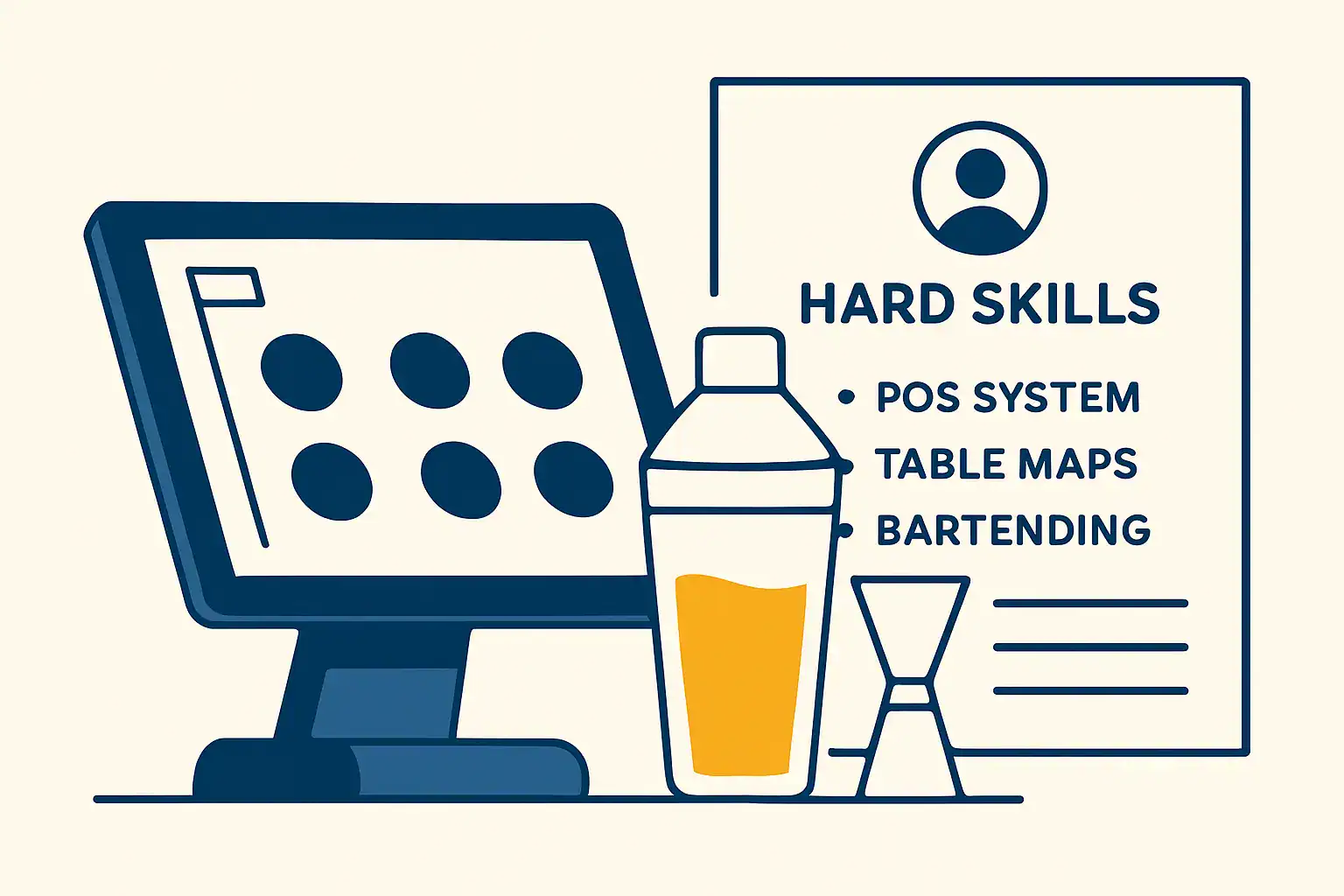
Hard skills are the technical abilities you need to perform the job. On a resume for bartender roles, these should be specific. Don’t just say “Mixology”; list the techniques you know, such as “Molecular Mixology,” “Infusions,” or “Syrup Preparation.” Mentioning proficiency with specific POS systems is also a huge plus, as it implies less training time.
Inventory management is another critical hard skill. Bar owners love bartenders who care about cost control. Mention if you have experience with ordering, stock rotation (FIFO), or conducting weekly audits. If you know how to tap kegs, troubleshoot soda guns, or maintain espresso machines, list these as well. For a broader look at essential abilities, see our article on best skills to put on a resume in 2026.
Soft Skills That Get You Hired
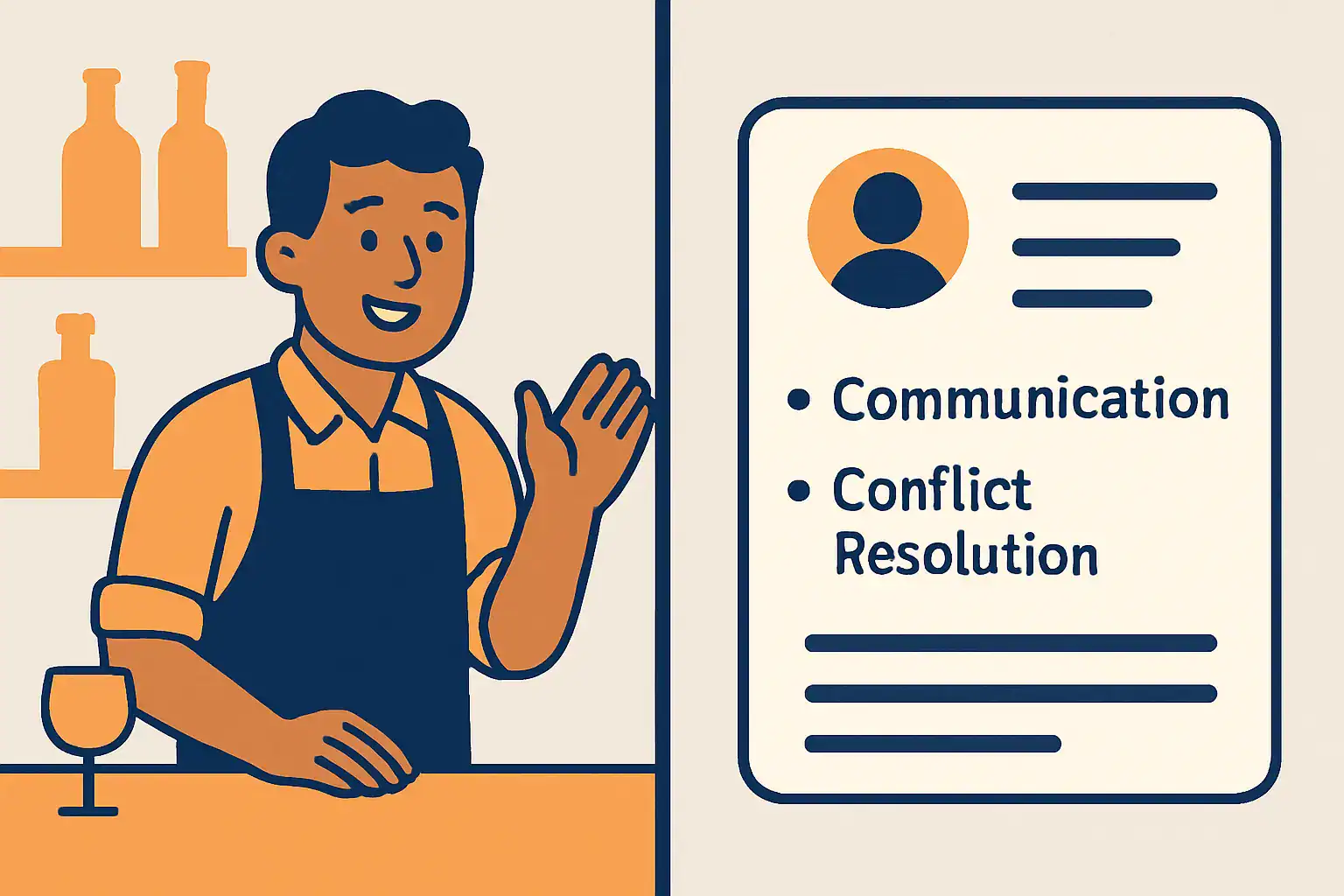
While making a great Old Fashioned is important, your personality is what keeps guests coming back. Soft skills are vital for a bartender resume sample. Communication is key—you need to listen to orders clearly in a loud environment and chat with guests to build rapport. However, adaptability and composure under pressure are equally important.
Conflict resolution is a major soft skill for bartenders. You are the gatekeeper of alcohol, which means you sometimes have to cut people off. Describing your ability to do this tactfully (e.g., “De-escalated potential conflicts with intoxicated patrons using non-aggressive communication techniques”) shows professionalism. If you are transitioning from a retail background, many of these skills are transferable. You can see how to frame these in our sales associate resume tips.
Certifications and Training
In the beverage industry, liability is a huge concern. Including certifications on your bartender resume can set you apart from uncertified candidates. It tells the manager, “I know the laws, and I won’t get your liquor license revoked.”
Common certifications include ServSafe Alcohol, TIPS (Training for Intervention Procedures), and local food handler cards. If you have attended a reputable bartending school, you can list it here, though experienced bartenders should prioritize real-world experience. If you are a member of the United States Bartenders’ Guild (USBG) or similar organizations, include that membership to show your commitment to the craft.
🍹 Build Your Resume Now
Formatting Your Bartender Resume
The look of your resume matters. A clean, professional layout makes a good impression. Use a reverse-chronological format, listing your most recent job first. This is what managers expect and it is the easiest for Applicant Tracking Systems (ATS) to read. Use clear headings and bullet points. Avoid dense blocks of text.
Keep your font professional—Arial, Calibri, or Helvetica are safe bets. Keep the font size between 10 and 12 points for the body text. Unless you have 10+ years of highly relevant experience, try to keep your resume to one page. Managers do not have time to flip through a novel. For more on length, read about how many pages should a resume be.
Tailoring for Different Bar Types
Not all bars are the same, and your resume shouldn’t be either. A resume bartender examples search will show you that a nightclub resume looks very different from a hotel bar resume.
- Nightclubs/High Volume: Focus on speed, efficiency, volume (sales numbers), and security collaboration. Mention “speed pouring” and “crowd control.”
- Fine Dining/Craft Cocktail: Focus on product knowledge, wine pairing, tableside service, and menu creation. Use terms like “artisanal ingredients” and “guest experience.”
- Neighborhood/Dive Bar: Focus on regulars, reliability, solo shifts, and trustworthiness with cash. Mention “building community” and “opening/closing solo.”
If you have experience in coffee service, which shares similarities with bartending in terms of workflow and machinery, you might find inspiration in our barista resume guide.
Handling Lack of Experience
Trying to break into the industry? You can still write a compelling resume. Focus on transferable skills from other customer service roles. Did you work as a server? You already know the menu and POS system. Did you work in retail? You know customer service and cash handling.
Consider starting as a barback. It is the traditional apprentice route. A barback resume should focus on physical stamina, stocking speed, and observation skills. Emphasize your willingness to learn and work hard. Even general customer service roles provide a solid foundation; see our guide on the perfect customer service resume for ideas on how to frame these skills.
Common Bartender Resume Mistakes
Even experienced pros make mistakes on their resumes. The biggest one is spelling errors. Misspelling a brand name (like “Johnny Walker” instead of “Johnnie Walker”) destroys your credibility as an expert. Attention to detail is part of the job.
Another mistake is getting too creative with the design. While you want to stand out, graphics and columns can confuse ATS software. Stick to a clean layout. Also, avoid listing irrelevant hobbies unless they directly relate to hospitality. For a full list of errors to avoid, check out our article on resume errors and fixes for 2026.
✨ Check My Resume Score
Optimizing for ATS (Applicant Tracking Systems)
Many large hotel chains and restaurant groups use ATS to filter applications before a human ever sees them. To pass this filter, you need the right keywords. Review the job description and use the exact words they use. If they ask for “inventory control,” don’t just write “counted bottles”—write “inventory control.”
Include keywords like “mixology,” “food safety,” “upselling,” “cash management,” and specific spirit names if relevant. However, ensure they flow naturally in your bullet points. Learn more about beating the bots in our guide to ATS resume optimization.
The Importance of a Cover Letter
Do you really need a cover letter for a bartending job? In many cases, yes. It is your chance to show your personality, which is 50% of the job. Use the cover letter to explain why you want to work at that specific bar. Did you visit and love their signature Old Fashioned? Mention it.
Keep it brief. Managers don’t want to read a memoir. Three paragraphs are enough: who you are, why you are a fit, and a request for an interview. If you have gaps in your employment or are switching careers, the cover letter is the place to explain that context.
Addressing Employment Gaps
The hospitality industry often has high turnover, but long unexplained gaps can be a red flag. If you took time off to travel, study, or care for family, be honest but brief. If you did freelance event bartending or private parties during that time, list it! “Freelance Event Bartender” covers a lot of ground and shows you stayed active in the industry.
Be prepared to discuss these gaps in an interview. Framing your weaknesses or gaps positively is crucial; see our tips on common weaknesses in job interviews.

Using Metrics to Prove Your Value
We mentioned numbers earlier, but it bears repeating. Metrics are the proof in the pudding. Did you help reduce pour cost? By what percentage? Did you organize an event that brought in record sales? How much?
- “Maintained beverage cost at 18%, consistently beating the target of 20%.”
- “Upsold top-shelf spirits, resulting in a $500 increase in weekly average sales.”
- “Served at private events with 500+ attendees, ensuring rapid service standards.”
Bartender Resume for Different Regions
Formatting norms can vary slightly by region. For instance, in some European countries or when applying for working holiday visas, the expectations might differ regarding photos or personal details. While US resumes strictly avoid photos, other markets might expect them. If you are looking for work in Canada or similar markets, reviewing specific examples like our customer service resume tips for Canada can provide insight into regional nuances.
📄 Generate Resume PDF
Final Checklist Before Sending
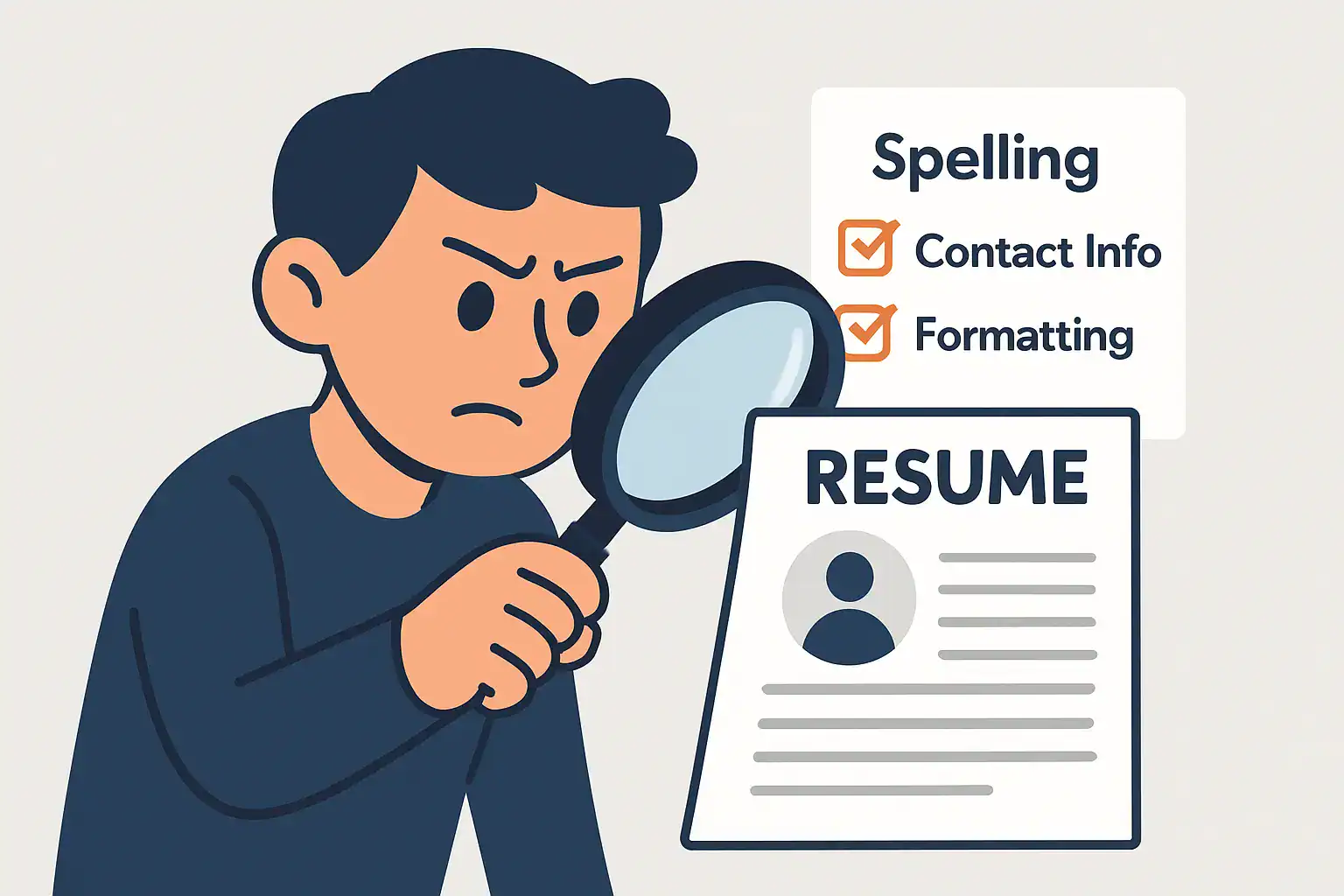
Before you hit send, go through this checklist. Is your contact info correct? (You’d be surprised how many people type their own phone number wrong). Is your email address professional? (partyanimal99@gmail.com is a no-go). Are your dates of employment accurate?
Read your resume out loud. This helps catch awkward phrasing. Have a friend read it to see if it makes sense to an outsider. Once you are confident, save it as a PDF (unless the application specifically asks for Word) to ensure the formatting stays perfect on every device.

FAQ: Bartender Resume
1. Should I include a photo on my bartender resume?
In the US, UK, and Canada, generally no. It can lead to bias issues and is not standard practice. However, providing a link to a LinkedIn profile or portfolio with professional images of you working or your cocktail creations is a great alternative.
2. How do I list freelance or private event work?
Group them under a single heading like “Freelance Bartender” or “Private Event Bartender.” List the date range (e.g., “2020 – Present”) and use bullet points to describe the types of events (weddings, corporate parties) and the skills used (setup, breakdown, inventory).
3. Do I need to list my high school education?
If you have a college degree or a relevant certificate, you can omit high school. If high school is your highest level of education, list it, but keep it brief. Experience is far more important in this industry.
4. What if I have no direct bartending experience?
Highlight customer service, multitasking, and cash handling from other jobs. Consider getting a certification like ServSafe or attending a reputable bar school to show commitment. Applying for barback positions is the best way to get your foot in the door.
5. How long should my bartender resume be?
One page is the gold standard. If you have 10+ years of experience, two pages are acceptable, but only if every bullet point adds value. Focus on the last 5-7 years of relevant work.
Author Information
Rebecca Lawson – Lead Resume & ATS Specialist
Rebecca Lawson is the Lead Resume & ATS Specialist at ResumeAITools, with 10+ years of experience helping job seekers across all industries improve their resumes and land better roles. With a Fortune 500 HR background, she understands exactly how ATS systems filter applicants and what hiring managers look for.
