

Key Takeaways
- In Australia, the ideal resume length for most jobs is 1–2 pages, depending on experience and role relevance.
- A one-page resume works best for students, graduates, casual work, and entry-level roles.
- A two-page resume is standard for professionals with several years of relevant experience.
- Resume length should be driven by relevance, clarity, and measurable achievements, not by filling space.
- Applicant Tracking Systems (ATS) prioritise structure and keywords, not how many pages your resume has.
Introduction
A resumé is not a life story. A resumé is a short business document that helps you get an interview. If you are applying in Australia, the first thing most people want to know is how long should a resume be and whether should a resume be 2 pages.
Here is the simple Australian standard: most resumés are 1–2 pages, and a longer document only works when every extra line is relevant and easy to scan. Recruiters and hiring managers in the Australian job market want clarity, proof, and clean formatting.
This guide also covers related questions people search at the same time, like how long should a cover letter be, how long should a cv be, how long should a curriculum vitae be, and whether can a cover letter be 2 pages.
Ryan Mitchell
Job Seeker • Canberra, ACT • Australia
Email: ryan.mitchell.cv@gmail.com • Phone: +61 473 829 516
Short Answer (Australia)
For most Australian jobs, a resume should be 2 pages long. This is the standard length expected by Australian employers and recruiters across most industries.
Why Australian Employers Prefer 2 Pages
Australian employers want enough detail to understand your experience, skills, and results,
without reading unnecessary information. A two-page resume allows space for:
• Relevant work history and responsibilities
• Achievements and outcomes
• Skills, tools, and systems used
• Education, licences, and certifications
Resume Length by Experience Level
Students / Graduates: 1–2 pages
Early to Mid-Career Professionals: 2 pages (ideal)
Senior or Management Roles: 2–3 pages (only if relevant)
Academic or Research Roles: 3+ pages may be acceptable
When a 1-Page Resume Works in Australia
• Entry-level or student roles
• Casual, retail, or hospitality jobs
• Limited work experience
• When the job advertisement specifically requests a short resume
Common Resume Length Mistakes
❌ Shrinking font size to force one page
❌ Including irrelevant or very old experience
❌ Submitting 4–5 pages for non-senior roles
❌ Listing duties without showing results
Safe Rule for Australian Job Seekers
If you are unsure, submit a clear, well-structured 2-page resume. Australian recruiters prefer relevance and clarity over resumes that are too short or unnecessarily long.
🚀 Create your resume quickly and for free!
Download our free resume templates
If you are writing from scratch, start with a simple resumé template: one column, clear headings, short bullet points, and consistent dates. A basic template is also more ATS-friendly.
A clean template helps you control resume length because it stops you from filling space with extra words. It also makes it easier to tailor each application, especially if you are applying for casual work, retail, or student roles.
You can also read Questions to Ask in an Interview to get ready with smart, relevant questions.
If you want to keep your content consistent across your job search, use the same core sections every time:
- Profile
- Key Skills
- Work Experience
- Education
- Certifications (if relevant)
- Referees (optional)
✨ Create your perfect resume now!
How Long Should a Resumé Be?
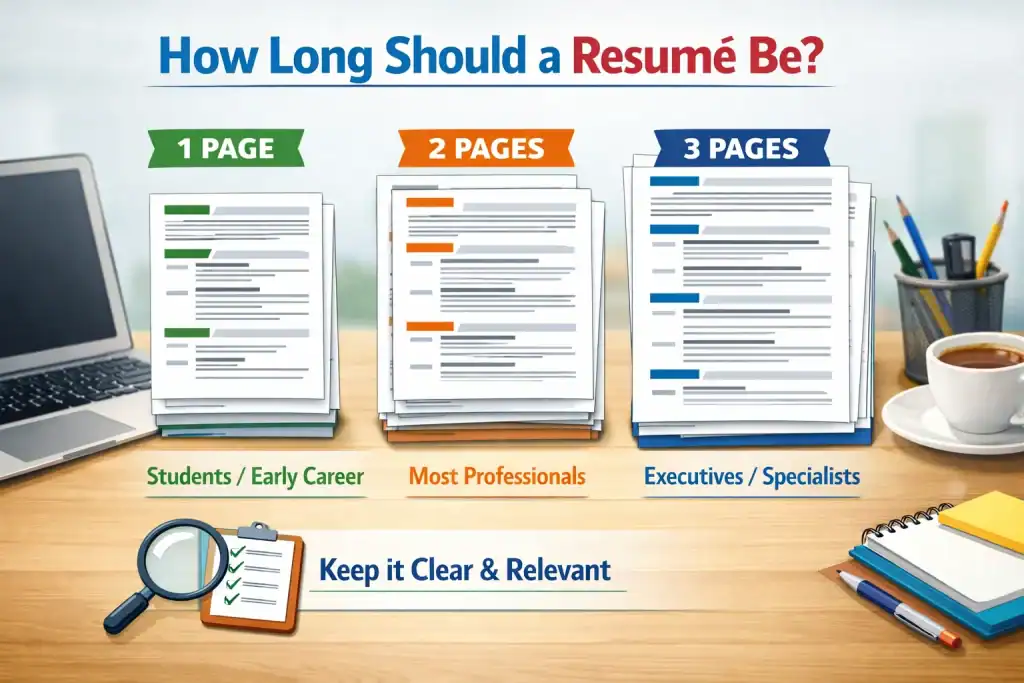
How Long Should A Resume Be For Australian Jobs? For most roles in Australia, a resumé should be 1–2 pages. One page works for students and early-career applicants. Two pages is normal for most professionals. Three pages is rare and usually only fits executive or specialist documents.
That is the answer. Now I will show you how to choose the right length for your situation and how to keep it tight.
You can also read Why Should We Hire You to learn how to give a clear, confident answer.
How Many Pages Should a Resumé Be?
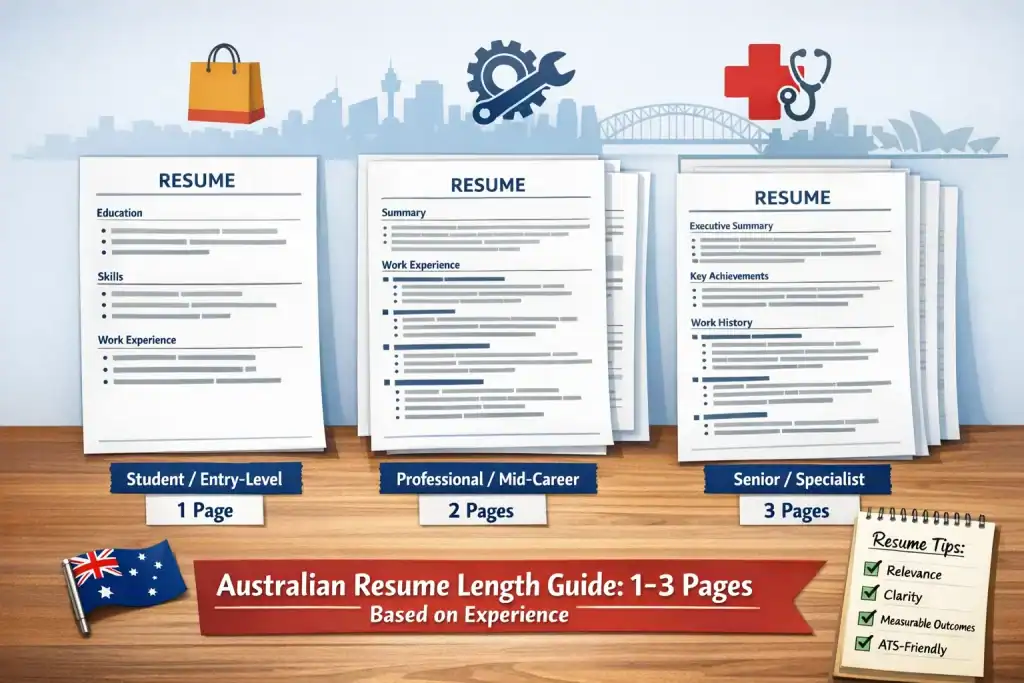
A good way to decide is to match length to evidence. If you have more proof that matches the job, you can use more space. If you are adding content that does not help you get hired, cut it.
Here’s the common Australian baseline:
- 1 page: student resume, first job, casual work resume, short history
- 2 pages: most roles with 3+ years of relevant experience
- 3 pages: rare, usually senior leadership or specialist roles
- CV: can be longer in academic or research contexts
Professional Experience
Professional experience is the main driver of length. If your work history is relevant and achievement-led, a second page helps.
If your experience is thin or not directly related, a second page can feel like padding. Australian recruiters notice padding fast.
A practical rule:
- 0–2 years experience: 1 page
- 3–10 years experience: 2 pages
- 10+ years: 2 pages, sometimes 3 if highly relevant
Industry Norms
Some industries in Australia tolerate more detail:
- Engineering and resources (engineering cv, project-heavy roles)
- Healthcare and regulated roles
- Government-style selection criteria roles (still keep the resumé concise)
Other industries prefer tighter resumes:
- Retail resume
- Hospitality and casual work
- Admin and customer service roles
In those roles, two pages can still work, but only if page two is relevant and easy to scan.
Relevance to the Position
Relevance is the most important filter. Your resumé is not a record of everything. Your resumé is a targeted document that matches one job.
Keep content that proves:
- you have done similar work
- you can deliver outcomes
- you have the right skills and tools
- you fit the pace and expectations
Cut content that is:
- old and unrelated
- repetitive duties
- generic claims without proof
Formatting and Readability
Formatting controls length more than people think. If your layout is clean, you can fit enough without cramming.
A readable Australian resumé usually uses:
- 11–12 pt font
- clear headings
- consistent spacing
- bullet points, not paragraphs
Avoid shrinking your text to fit one page. One page is not a goal. A clear document is the goal.
You can also read What Is a CV to understand how it’s used across different countries.
Applicant Tracking Systems (ATS)
Applicant Tracking Systems (ATS) scan structure and keywords. ATS does not reject you because of page count. ATS rejects you when it cannot read your file properly or it cannot match your keywords.
To stay ATS-friendly:
- use simple headings (Profile, Skills, Experience, Education)
- avoid tables, columns, and text boxes
- keep dates consistent
- save as PDF unless the employer asks for Word
If you are using resume examples australia or sample resume australia templates online, pick the simplest format. Fancy designs often break parsing.
✨ Make your resume shine fast!
What’s the Difference Between a Resumé and a CV?
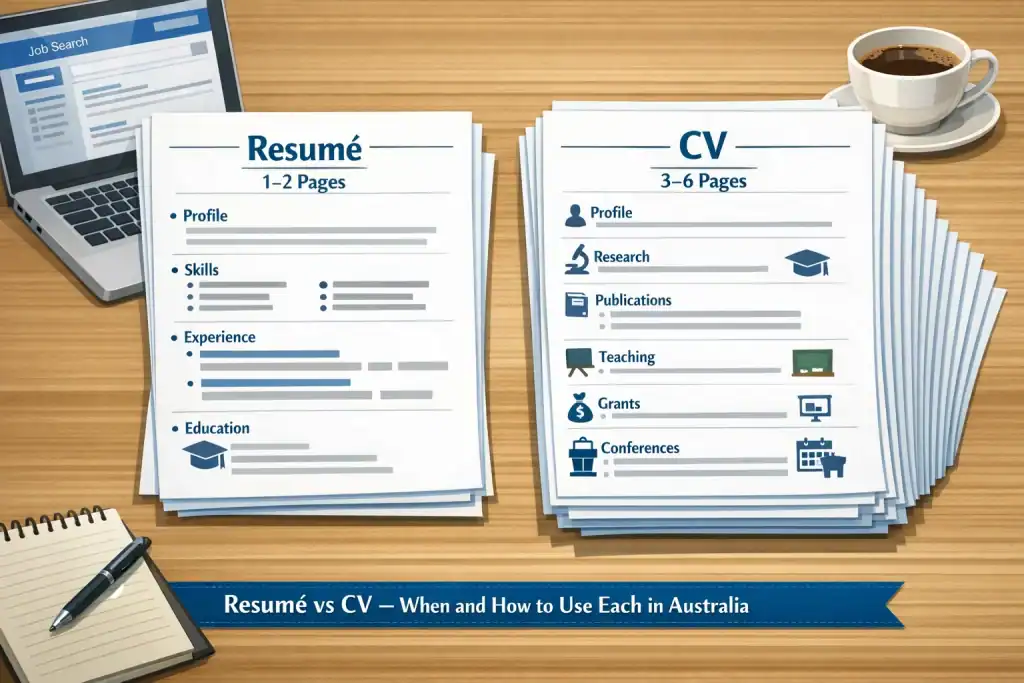
In Australia, “resumé” and “CV” are often used interchangeably, but the intent can differ by industry.
A resumé is typically short and job-focused.
A CV (curriculum vitae) can be longer and more detailed, especially in academia or research.
People also search “cv australien” because international advice is inconsistent. Australian expectations are usually simple: follow the job ad language and keep it readable.
When Do You Send a Resumé?
Send a resumé for:
- most jobs on Seek, CareerOne, LinkedIn, Indeed
- retail and customer service roles
- admin, operations, sales, and general corporate roles
- casual work and part-time roles
A resumé is usually 1–2 pages.
When Do You Send a CV?
Send a CV for:
- academic roles
- research roles
- roles requiring publications, grants, teaching history
- some medical, specialist, or consulting roles
A CV can be longer because it documents depth.
Comparison Between a Resumé and CV
Length
- Resumé: usually 1–2 pages
- CV: can be 2–6+ pages in academic settings
Content
- Resumé: skills + achievements + relevant work history
- CV: full history, publications, research, awards, conferences
Focus
- Resumé: targeted to one job
- CV: comprehensive career record
Sections
- Resumé: Profile, Skills, Experience, Education
- CV: adds Research, Publications, Teaching, Grants, Conferences
🚀 Boost your career today!
9 Ways to Keep Your Resumé Concise
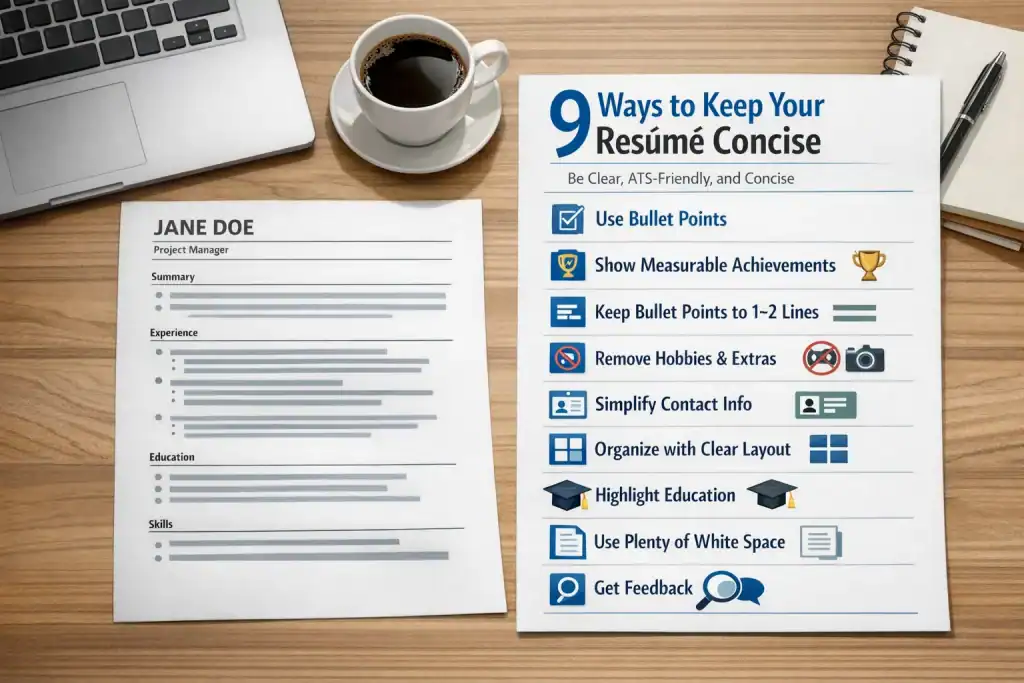
If you are stuck asking how long can resume be, the real fix is editing. These are the rules I use to cut length without cutting impact.
You can also read Chat GPT Cover Letter to see how AI can help structure your letter while keeping it personal.
1. Keep the Description of Each Role to 3–7 Bullet Points
Use 3–5 bullets for recent roles.
Use 2–3 bullets for older roles.
For very old roles, use 1 line or remove it.
This also cleans up your job history on resume so it looks modern.
2. Include Impressive, Measurable Achievements
Swap duties for outcomes:
- “Handled customer enquiries” becomes “Resolved 30–50 customer enquiries per shift and maintained high satisfaction.”
When you add measurable achievements, you often need fewer bullets.
3. Limit Each Bullet Points to 2 Lines
Two lines forces clarity. If a bullet is longer, it usually contains extra filler.
Good bullet structure:
- Action + scope + tool + result
4. Don’t Include Irrelevant Hobbies
Hobbies usually do not help. Keep hobbies only if they prove something relevant, like leadership, volunteering, or competition.
5. Condense Contact Information
Use one line for contact details. Skip full street address. City and state is enough in Australia.
6. Choose a Clean and Readable Format
A clean format supports ATS and humans. It also prevents accidental extra length from messy spacing.
This matters even more if you are applying for a student resume or casual work resume, where recruiters scan fast.
7. Limit Education Details
If you have experience, education is short:
- Qualification, school, year
If you are a student or graduate, education can be longer, but keep it relevant.
8. Optimise White Space
Use enough white space for readability, but don’t waste half the page with oversized headers or huge gaps.
9. Seek Feedback From Others
Ask someone to scan your resumé for 10 seconds and answer:
- What role is this for?
- What are the top 3 strengths?
- What proof stands out?
If they can’t answer, your resume is too long and too vague.
✨ Create your perfect resume now!
Download Your Resumé Template
If you are searching how to write a resume with no experience, start with a tight one-page template:
- Profile (3–4 lines)
- Key Skills (8–12 bullets)
- Projects, volunteering, or part-time work
- Education and certifications
For career changers, keep the profile and skills strong, then include relevant achievements even if they came from volunteering or study projects.
Summary
For Australian jobs, resume length should support clear, targeted communication rather than personal history. Most candidates succeed with a one- or two-page resume that highlights relevant skills, recent experience, and measurable outcomes. By focusing on role-specific content, clean formatting, and ATS-friendly structure, job seekers can create resumes that meet Australian hiring expectations and improve their chances of securing interviews.
You can also read Is a CV a Resume to clearly understand the difference between the two.
FAQs
What is the Recommended Length for a Resumé?
1–2 pages is the recommended length for most Australian jobs.
How Does Professional Experience Impact Resumé Length?
More relevant experience usually means 2 pages. Early career applications usually fit 1 page.
Are There Industry-Specific Guidelines for Resumé Length?
Yes. Engineering and specialist roles can justify more detail. Retail and casual roles should stay tight and simple.
How Should I Tailor My Resumé Length Based on the Job I’m Applying For?
Cut unrelated content, prioritise recent achievements, and keep older roles short. Tailoring usually improves length automatically.
Is There an Ideal Resumé Length for Applicant Tracking Systems (ATS)?
ATS does not care about page count. ATS cares about readable structure, clear headings, and keywords.
What Are the Formatting Considerations for Maximising Resumé Space?
Use 11–12 pt font, short bullets, consistent spacing, and one-column layout. Avoid tables and columns.
How Can Recent Graduates Optimise Their Resumé Length?
Keep it one page and fill it with relevant proof: projects, volunteering, part-time work, and skills.
In What Cases Should a CV Be Used Instead of a Resumé?
Use a CV for academic, research, and publication-based roles. A CV can be longer than a resumé.
Can a Resumé Be Longer Than Two Pages?
Yes, but it is rare. It usually only works for senior executives or specialist roles where all content is relevant.
Author Information
Anny Kuratulain | Career Development Expert
Anny Kuratulain is a seasoned professional with over 9 years of experience in social media strategy, freelance coaching, and resume optimization. Specializing in helping professionals in various fields, Anny provides expert guidance on crafting resumes that stand out to hiring managers and Applicant Tracking Systems (ATS). Anny’s insights focus on empowering job seekers to highlight their key strengths, tailor resumes to job descriptions, and land the jobs they desire.
