

Key Takeaways
- In Australia, 1–2 pages is the standard resume length, with one page for early career and two pages for most professionals.
- A two page resume is widely accepted when experience and achievements are relevant to the role.
- Resume length should be driven by relevance and results, not by trying to fit everything onto one page.
- Applicant Tracking Systems (ATS) prioritise clear structure and keywords, not page count.
- A resume longer than two pages is only appropriate for senior, executive, or specialist CVs where every section adds value.
Introduction
If you’re asking How Many Pages Should A Resume Be In Australia, you’re probably about to submit an application and don’t want your resume length to cost you an interview. Fair.
Here’s the simple rule I use for the Australian job market: a one-page resume is fine for early career, and a two page resume is normal for most professionals. A longer document is only worth it when every extra line adds relevant proof.
This guide walks through Australian CV rules, layout, ATS basics, and real examples. I’ll also cover related questions people ask at the same time, like how long should a cover letter be, how long should a resume be, and how long should a cv be.
Oliver Bennett
Job Seeker • Perth, WA • Australia
Email: oliver.bennett.cv@gmail.com • Phone: +61 449 372 816
Short Answer (Australia)
In Australia, a resume should usually be 2 pages long. This is the standard length preferred by most Australian employers and recruiters.
Why Australia Prefers 2 Pages
Australian employers expect enough detail to understand your experience, skills, and results.
Unlike some countries, a one-page resume is often considered too short for full-time roles.
Two pages allow space for:
• Relevant work history
• Achievements and responsibilities
• Skills and tools used
• Education and certifications
Resume Length by Experience Level
Students / Graduates: 1–2 pages
Early to Mid-Career Professionals: 2 pages (ideal)
Senior or Management Roles: 2–3 pages (only if relevant)
Academic or Research Roles: 3+ pages may be acceptable
When a 1-Page Resume Is Acceptable
• Entry-level or student roles
• Casual, retail, or hospitality jobs
• Limited work experience
• When the job advertisement specifically requests a short resume
Common Mistakes to Avoid
❌ Shrinking font size to force one page
❌ Including irrelevant or outdated roles
❌ Submitting 4–5 pages without a senior-level reason
❌ Listing duties without showing results
Safe Rule for Australian Job Seekers
If you are unsure, submit a clear, well-formatted 2-page resume. Australian recruiters prefer relevance and clarity over overly short or overly long resumes.
🚀 Create your resume quickly and for free!
CV vs. Resume in Australia
In Australia, “resume” and “CV” get used interchangeably, but employers often mean different things.
A resume is usually a concise job application document. A CV (curriculum vitae) is often longer and more detailed, and it shows depth in research, academic work, publications, or specialist roles.
If you’re unsure which one to use, check the job ad wording. If it says “resumé” or “resume,” follow that. If it says “CV,” use the format expected in that industry.
Understanding Australian CV Requirements
Australian employers expect a clear structure, clean formatting, and evidence. They also expect you to tailor the content to the role and keep it readable for Applicant Tracking Systems (ATS).
Your resume length matters, but not as much as content quality. Most hiring managers will choose a sharp two pages over a weak one page.
CV Tips and Rules
These are the Australian CV tips I see working consistently:
- Use simple headings and consistent dates
- Write short bullet points, not paragraphs
- Put outcomes first (numbers, results, scope)
- Keep personal details minimal
- Use Australian spelling where possible
- Save as a PDF unless the employer asks for Word
If you are also learning how to write a resume or how to type resume, keep your layout plain. Fancy design often breaks ATS reading.
✨ Create your perfect resume now!
Australian CV Format, Order, and Layout
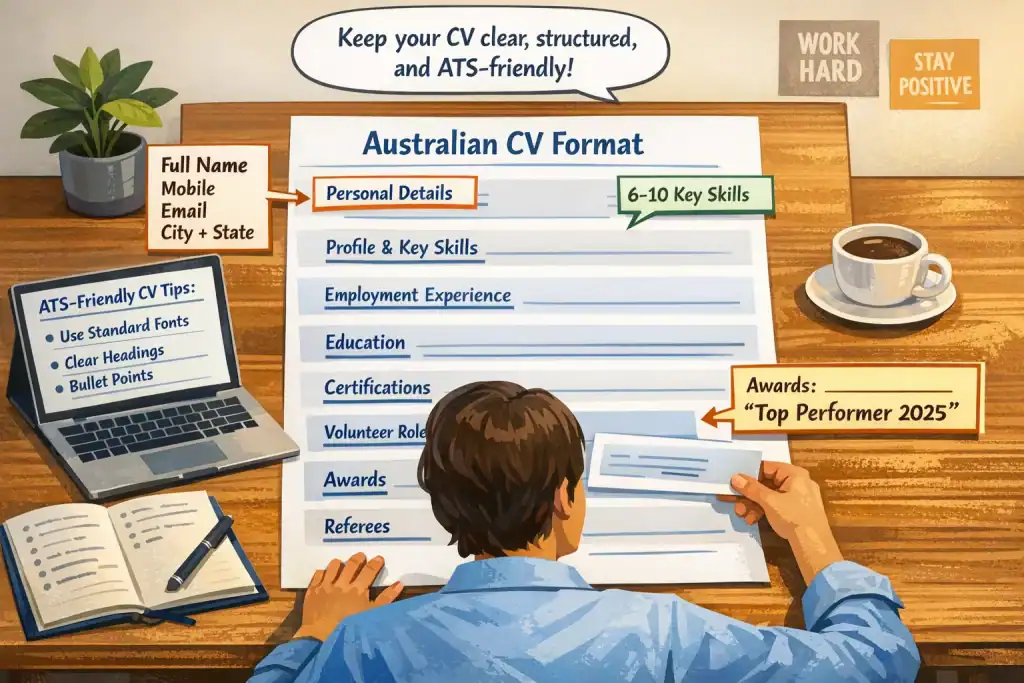
A strong Australia CV format follows a predictable order. That’s good. Recruiters like predictable. ATS likes predictable too.
A common Australia CV order looks like this:
- Personal details
- Profile and key skills
- Employment experience and achievements
- Education and qualifications
- Certifications
- Volunteer roles (optional)
- Awards and distinctions (optional)
- Referees (optional)
Personal Details
Include:
- Full name
- Mobile number
- Professional email
- City + state (Sydney NSW, Melbourne VIC, Perth WA)
Many people ask: should you put your address on your resume? In Australia, you usually do not need a full street address. City and state is enough.
If you’re applying from overseas (New York, London), still use an Australian-friendly location line, like “Melbourne VIC (relocating)” if true.
Profile and Key Skills
Your profile is your first “scan test.” Keep it 3–5 lines.
Add 6–10 key skills that match the job ad. These help ATS and help the recruiter understand your fit quickly.
Awards and Distinctions
Awards are optional, but they can support your credibility:
- “Top performer award (2025)”
- “Safety recognition”
- “Employee award”
Use one line per award.
Education and Qualifications
List:
- Qualification title
- Institution
- Year (or expected year)
For a first time job resume, education can sit higher on the page, especially when work history is short.
Employment Experience and Achievements
Your experience section should be achievement-led. I prefer this bullet format:
- Action verb + task + tool + result
Example:
- “Improved weekly reporting accuracy by updating Excel checks and reducing data entry errors.”
Volunteer Roles
Volunteer roles matter when they prove skills, especially for early-career applications.
Referees
Referees are optional. Many candidates write:
- “Referees available on request.”
If you include them, make sure details are current.
Tailoring Your Australia CV/Resume
Tailoring is how you keep your resume length tight while increasing relevance. A tailored resume usually needs fewer words to prove fit.
For Specific Roles
Use the job ad to decide:
- Which skills to highlight
- Which achievements to include
- Which older roles to cut
If you’re applying for “CV Melbourne” roles (or any city-specific keyword search), keep your experience relevant to local employer expectations and Australian terminology.
Adapting to Australian Work Culture
Australian work culture often values:
- clear communication
- reliability
- practical problem-solving
- teamwork without ego
- calm professionalism
If you want internal reading that matches this topic, link your site’s pages using these exact terms:
- words to describe yourself
- skills to put on resume
- weaknesses in job interview
- questions to ask in an interview
- why should we hire you
🚀 Start building your dream resume today!
Optimizing for Applicant Tracking Systems (ATS)
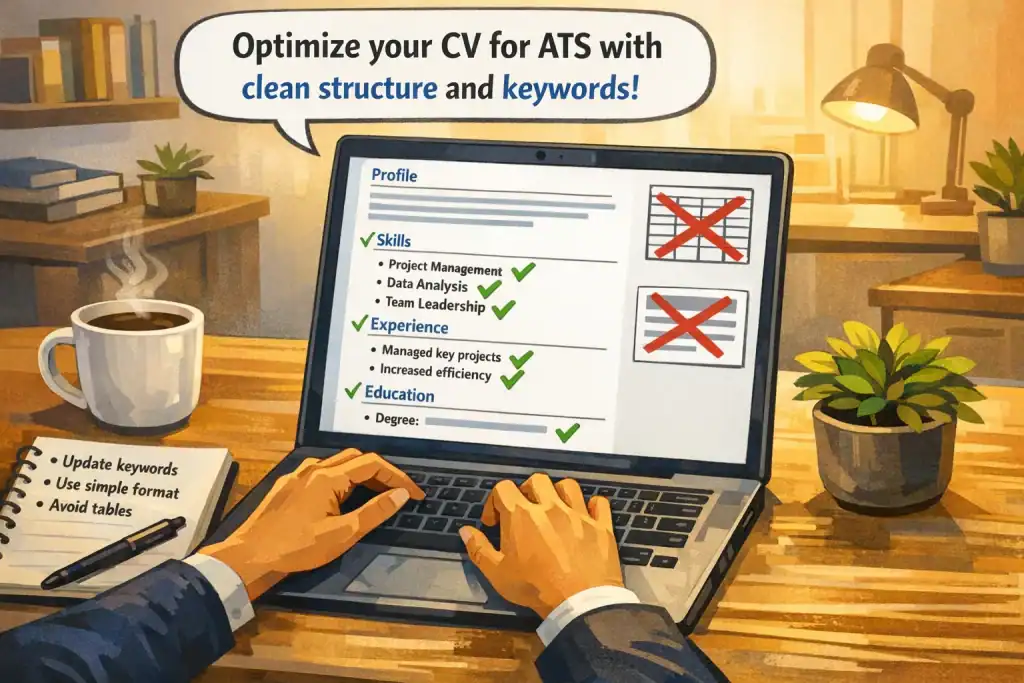
ATS is common in Australia, especially in medium to large employers and recruitment agencies. ATS does not “reject” you based on pages alone. ATS mainly cares about readable structure and keyword match.
CV Keywords and ATS
To support ATS:
- Use standard headings (Profile, Skills, Experience, Education)
- Put keywords in Skills and Experience
- Avoid tables, columns, and text boxes
- Use a simple font and consistent spacing
A clean structure improves ATS reading and reduces parsing errors.
Highlighting Key Sections
When your structure is right, your resume length becomes easier to control. These sections do most of the work.
Work Experience
Keep work experience relevant and recent. A simple rule:
- Last 5–10 years gets the most detail
- Older roles get 1–2 lines, or get removed if unrelated
Skills
Use a skills list that matches the role. Keep it specific, not generic.
Examples of Skills
- Communication
- Customer service
- Stakeholder management
- Excel reporting
- Scheduling and coordination
- Safety compliance
- Project support
For more detail, link internally to skills to put on resume.
Volunteer Work
Volunteer work is useful when it shows real responsibility, outcomes, and skills.
Examples of Including Volunteer Work
- “Volunteer Event Assistant — managed registrations and attendee support for 200+ guests.”
- “Community Tutor — supported weekly learning goals and tracked progress.”
Certifications
Certifications are a fast trust signal in Australia. Keep them neat and recent.
Examples of Listing Certifications
- “First Aid/CPR (current)”
- “RSA (VIC)”
- “White Card (WA)”
- “Forklift Licence (LF)”
Career Objective
A career objective is best for entry-level candidates. Keep it short and role-specific.
Example:
“Seeking an admin support role where I can apply strong communication, organisation, and scheduling skills in a busy office.”
Contact Details
Keep contact details simple and professional. Make it easy for recruiters to reach you fast.
✨ Make your resume shine fast!
Resume/CV Length
This is the section you came for. I’ll keep it practical and Australia-specific.
How Many Pages Should a Resume/CV Be?
For most job seekers, how many pages should be in a resume in Australia is answered like this:
- 1 page: students, early career, short work history
- 2 pages: most professionals and technical roles
- 3 pages: rare, usually senior specialists or executives with highly relevant depth
- CVs: can be longer in academia or research
This is the heart of resume length advice: quality over quantity.
Professional Experience
More relevant experience can justify more space. That does not mean listing everything you ever did. It means choosing the work that matches the role.
If you have 8–12 years in one area, two pages is normal.
Industry Norms
Some industries expect slightly more detail:
- engineering
- healthcare
- government-adjacent roles
- technical project roles
If your industry expects detail, use page two for outcomes, tools, and scope. Don’t use page two for filler.
Relevance to the Position
Relevance controls length. If a line does not help the job you want, remove it.
This matters for people asking how many pages can a resume be or how long can resume be. There is no legal limit. There is an attention limit.
Formatting and Readability
You can fit a lot on a page, but squeezing content makes it harder to read.
Use:
- 11–12 pt body text
- clean spacing
- short bullet points
If you try to “win” by shrinking font, recruiters notice.
Applicant Tracking Systems (ATS)
ATS likes:
- clean headings
- consistent formatting
- simple bullet lists
ATS does not reward long documents. ATS rewards match and readability.
Seniority and Resume Length
Career stage changes the ideal length.
Graduate Resume Length
A graduate resume is usually 1 page. A second page is fine if you have:
- internships
- strong projects
- volunteering with outcomes
- certifications
This is where people also ask about a one page cv. In Australia, a one-page resume is normal for graduates. A true academic CV is different.
Management Resume Length
Managers often sit at 2 pages. Your value is decision-making, delivery, and leadership outcomes. You need enough space to show that clearly.
Executive Resume Length
Executives can reach 2 pages comfortably. 3 pages can be acceptable only when content is highly relevant and achievement-led.
People search how many pages for professional resume because they worry two pages looks “too long.” In Australia, a well-written two-page professional resume is standard.
🚀 Boost your career today!
Keeping Your Resume Concise
If you are struggling to fit, use these practical rules.
Role Descriptions: 3-7 Bullet Points
Aim for:
- 3–5 bullets for recent roles
- 2–3 bullets for older roles
- 1–2 lines for unrelated roles (or remove)
Impressive, Measurable Achievements
Replace duties with outcomes:
- “Managed inbox” becomes “Resolved 40+ client requests weekly with high accuracy.”
Limit Bullet Points to 2 Lines
Two lines is enough for most bullets. If a bullet runs long, cut the extra detail or split it.
Exclude Irrelevant Hobbies
Most hobbies do not help. Keep hobbies only when they add credibility (leadership, volunteering, sport at a competitive level).
Condense Contact Information
Do not waste space with:
- full address
- multiple emails
- unnecessary links
Clean, Readable Format
A clean format helps ATS and helps humans. It also reduces repetition and cuts length naturally.
Limit Education Details
If you have years of experience, education can be short:
- degree, institution, year
- 1–2 highlights only if relevant
Optimize White Space
White space helps readability, but too much wastes space. Balance is key.
Seek Feedback
If you’re unsure, ask someone to scan it for 10 seconds and tell you:
- role fit
- strongest skills
- strongest outcomes
That feedback often shows what to cut.
Creating a Professional Layout
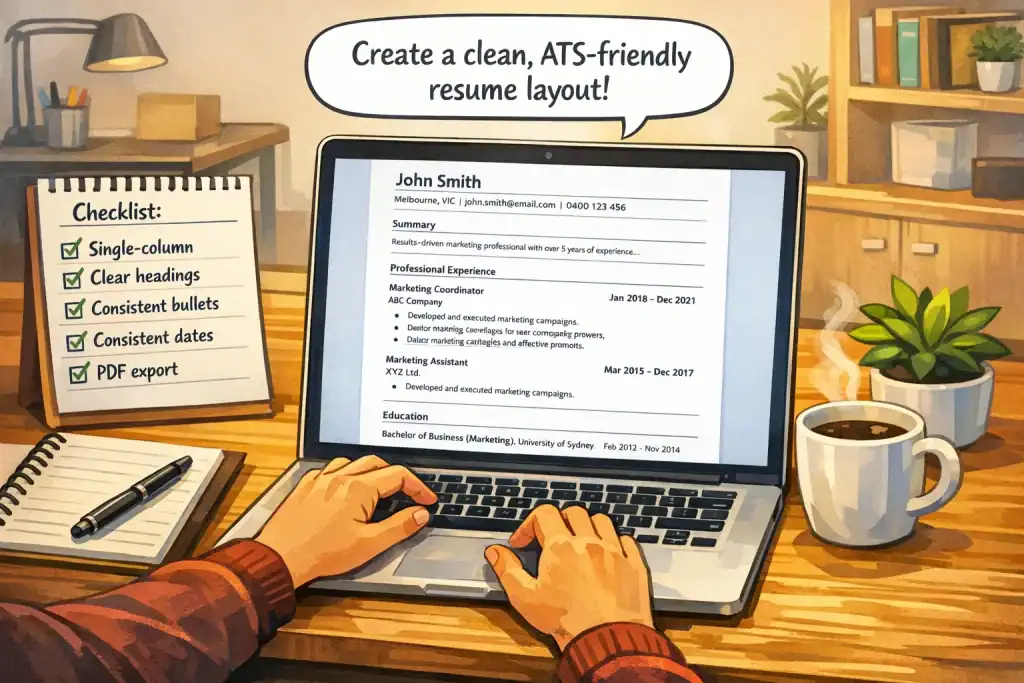
A professional layout is readable, ATS-friendly, and consistent. It answers the question: what does a perfect resume look like in Australia?
A “perfect” resume is not a design masterpiece. It is a clean document that shows relevant outcomes fast.
Checklist:
- single-column layout
- clear headings
- consistent bullet style
- consistent dates (Month Year)
- PDF export that keeps formatting stable
What to Avoid In Your Australian CV
These are common reasons resumes get ignored in Australia:
- long paragraphs
- vague claims with no proof
- too many old roles
- cluttered design or multi-column templates
- unrelated skills lists
- changing tense and formatting
If you’re also planning your cover letter, avoid sending a giant cover letter with a short resume. Your documents should match in tone and focus.
Tips to Perfect Your Australia CV
- Put your best evidence on page one
- Use keywords naturally in Skills and Experience
- Keep the summary short
- Use numbers when you can
- Remove repeated duties across roles
- Make job titles and dates easy to scan
If you want more interview-side prep, use internal links:
- questions to ask in an interview
- why should we hire you
- weaknesses in job interview
Resume Writing Do’s and Don’ts
Do:
- tailor to each role
- keep bullet points outcome-led
- use Australian spelling when possible
- keep it ATS-readable
Don’t:
- shrink font to cram content
- add irrelevant detail
- copy-paste generic responsibilities
- exaggerate titles or skills
If you’re learning how to write a resume from scratch, start with structure first. The content becomes easier after that.
Australian CV Examples
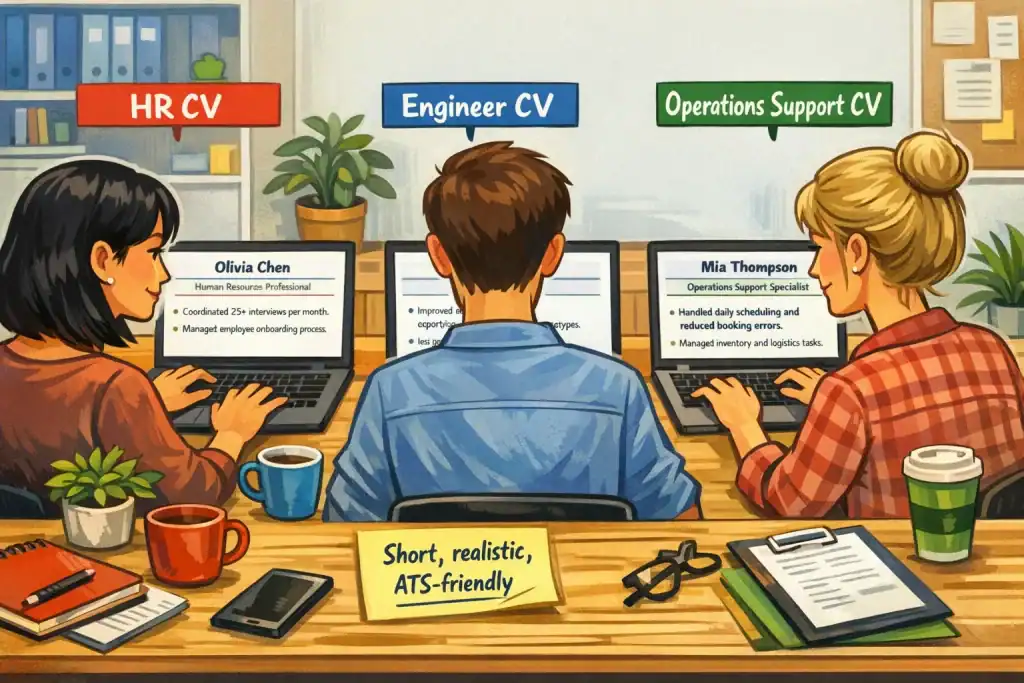
These examples are short, realistic, and ATS-friendly.
HR Australia CV Example
Name: Olivia Chen (Sydney NSW)
Target role: HR Coordinator
Profile: HR professional with 4+ years supporting recruitment coordination, onboarding, and HR admin. Strong stakeholder communication and high attention to detail.
Key Skills: ATS screening support, interview scheduling, HRIS updates, policy admin, data accuracy
Experience bullet examples:
- “Coordinated 25+ interviews per month and improved candidate follow-up time by tightening the workflow.”
- “Supported onboarding and maintained accurate HR records across multiple departments.”
Engineer CV Example Australia
Name: Lachlan Patel (Perth WA)
Target role: Project Engineer
Profile: Engineer with strong documentation skills and practical project support experience. Comfortable with compliance, reporting, and stakeholder updates.
Key Skills: project coordination, reporting, safety compliance, problem-solving, documentation
Experience bullet examples:
- “Improved reporting accuracy by standardising templates and tracking actions consistently.”
- “Supported site coordination and ensured documentation met required standards.”
Australian CV example
Name: Mia Thompson (Melbourne VIC)
Target role: Operations Support
Profile: Reliable operations support professional with experience in scheduling, customer service, and admin coordination. Strong organisation and communication.
Key Skills: scheduling, customer support, Excel, data entry, process improvement
Experience bullet examples:
- “Handled daily scheduling and reduced booking errors by improving check steps.”
- “Maintained accurate records and supported smooth team handovers.”
Other Sections for Your Australian CV
Optional sections that can add value without bloating pages:
- short projects section (if relevant)
- volunteering (if it proves skills)
- certifications (always useful when role-relevant)
- LinkedIn link (if your profile matches your resume)
Cover Letter Writing
People often search resume length and cover letter length together, so here’s the practical answer.
- how long should a cover letter be in Australia? Usually half a page to one page.
- Most cover letters land best at 250–400 words. That covers how many words should a cover letter be for typical roles.
- If you’re asking how long does a cover letter need to be, the shortest good answer is: long enough to match the job needs with proof, short enough to stay readable.
A clear cover letter length structure:
- 2–3 lines: why this role
- 3–5 lines: proof you can do it (1–2 examples)
- 2–3 lines: why you fit the team
- 1–2 lines: close + availability
People also ask: can a cover letter be 2 pages? It can, but it usually should not. Two pages is rarely necessary in Australia.
If you want help drafting, link internally using chat gpt cover letter.
Resume Services
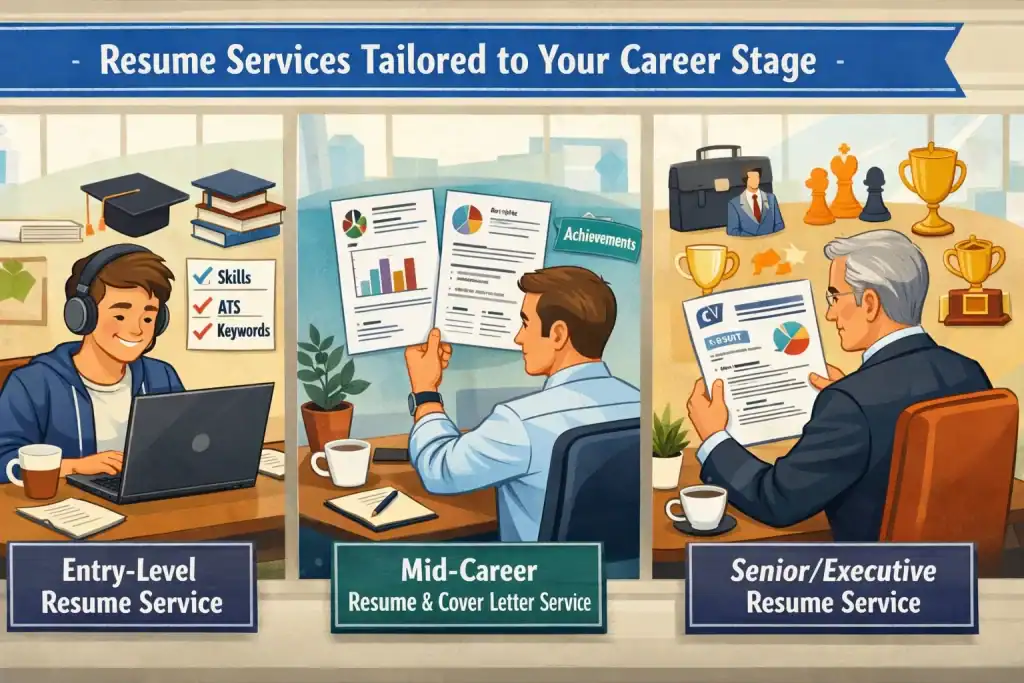
Some people prefer help, especially when applying for competitive roles or switching industries. That’s where searches like resume services near me, resume writing services near me, and review my perfect resume come from.
Entry Level Resume Writing Service
Best for:
- students
- graduates
- a first time job resume
- role changes with limited experience
A good entry-level service helps structure, skills, and ATS keywords without inflating length.
Professional Resume and Cover Letter Service – Mid-Career
Best for:
- 4–10 years of experience
- people targeting higher pay bands
- candidates applying through recruitment agencies Australia
Mid-career work often needs a strong page two, with achievements and scope.
Senior Professional & Executive Resume Writing Service
Best for:
- senior managers
- heads of function
- CEO candidates
Executive resumes must be outcome-led, not duty-led. This is where executive resume writing services are often worth it.
Professional Resume and Cover Letter Service
If you pay for support, ask for:
- ATS-friendly formatting
- a tight two-page resume version
- a matching cover letter version
- editing support so it still sounds like you
If you’re searching best rated resume writing services, compare based on samples and clarity, not fancy claims.
Summary
How Many Pages Should A Resume Be In Australia is a simple question with a practical answer: one page for early career, two pages for most professionals, and longer only when every extra line is relevant and strong.
If you’re stuck choosing between cutting content or adding a second page, pick clarity. A clean, ATS-friendly two page resume with strong achievements is better than a crowded one-page document.
✨ Create your perfect resume now!
FAQs
What is the recommended length for a resumé?
In Australia, the recommended length is 1–2 pages. One page works for early career. Two pages is normal for most professionals.
How does professional experience impact resumé length?
More relevant experience can justify a second page. Keep older roles shorter and focus detail on the last 5–10 years.
Are there industry-specific guidelines for resumé length?
Yes. Technical roles, engineering, healthcare, and specialist roles often use two pages more comfortably. Academic and research roles may require a longer CV.
How should I tailor my resumé length based on the job I’m applying for?
Cut unrelated content and expand only the experience that matches the job ad. A tailored resume usually stays within two pages without effort.
Is there an ideal resumé length for applicant tracking systems (ATS)?
ATS prefers readable structure, not a specific page count. A clean one or two page resume usually parses best.
What are the formatting considerations for maximising resumé space?
Use 11–12 pt font, consistent spacing, short bullets, and clean headings. Avoid shrinking fonts or cramming text.
Author Information
Anny Kuratulain | Career Development Expert
Anny Kuratulain is a seasoned professional with over 9 years of experience in social media strategy, freelance coaching, and resume optimization. Specializing in helping professionals in various fields, Anny provides expert guidance on crafting resumes that stand out to hiring managers and Applicant Tracking Systems (ATS). Anny’s insights focus on empowering job seekers to highlight their key strengths, tailor resumes to job descriptions, and land the jobs they desire.
