
Key Takeaways 🌟
- A strong resume summary or objective statement introduces your skills and experience, making a positive first impression.
- Quantifying achievements (e.g., savings, efficiency gains) in the work experience section demonstrates your impact and sets you apart.
- Tailor your resume to the specific job you’re applying for by using industry-specific keywords and focusing on relevant experience.
- Highlight both hard skills (e.g., accounting software proficiency, financial reporting) and soft skills (e.g., communication, problem-solving) to make your resume more well-rounded.
- Avoid common mistakes like overloading your resume with irrelevant information, using improper formatting, or neglecting to optimize for ATS.
Introduction 📝
Creating a winning accountant resume is crucial if you want to stand out in the competitive accounting field. Whether you’re aiming for an entry-level role, senior position, or a specialized accounting role, your resume must reflect your skills, experience, and professional achievements.
🚀 Create your resume fast, free!
Guadalupe S. Early
Accountant • Louisville, KY, USA
Email: GuadalupeSEarly@gmail.com •
Phone: 502-574-7327
Profile
Detail-oriented accountant with strong analytical skills and experience supporting financial operations, reporting, and compliance. Proven ability to improve workflow efficiency, maintain accurate records, and support cross-functional teams in fast-paced environments.
Experience
Administrative Aide – Lakeshore Community Services, Louisville, KY (2020–2024)
Managed calendars, processed financial documentation, and supported daily accounting operations. Improved filing efficiency by 30% and provided administrative support to a team of 12 staff members.
Office Assistant – Westfield Consulting Group, Louisville, KY (2017–2020)
Coordinated meetings, handled correspondence, prepared financial reports, and maintained data accuracy above 98% through consistent quality checks.
Education
Associate Degree in Business Administration – Harold Washington College, Chicago, IL (2015–2017)
High School Diploma – Lane Tech College Prep, Chicago, IL (2011–2015)
Skills
Financial Reporting • Microsoft Excel • Data Analysis • Document Management • Scheduling • Accounting Support • Attention to Detail • Communication • Time Management
Certificates
Administrative Support Certification – American Management Association (2018)
Why a Strong Accountant Resume Matters 📈
The importance of a well-written resume cannot be overstated, especially in accounting. As someone who works with numbers and financial data, your resume needs to convey precision, attention to detail, and an understanding of key industry standards. A resume is your personal marketing tool—it’s your chance to tell a hiring manager why you’re the best candidate for the role.
Leadership and accountability matter across professions. The Project Manager Resume Example for Job Success demonstrates how results-driven experience is presented clearly.
When hiring managers review resumes, they are looking for skills, experience, and qualifications. The challenge lies in presenting yourself in a way that stands out while also ensuring that your resume is ATS-friendly (Applicant Tracking System) to help get your resume through automated filters.
✨ Build your perfect resume now!
The Essential Sections for an Accountant Resume 🏗️
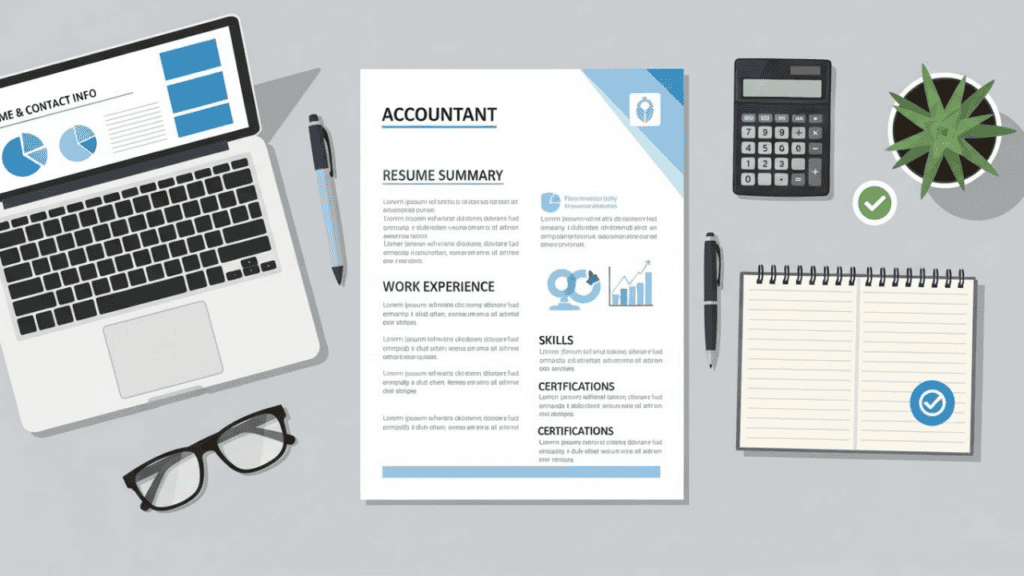
The structure of your resume matters as much as its content. A clean layout, combined with organized sections, will allow hiring managers to quickly assess your qualifications. Here’s how you should structure your resume:
The Resume Header: Your First Step to Professionalism 📛
This section includes your name, contact information, and a professional title if applicable. Don’t overcomplicate it. Keep it simple but professional.
- Full name
- Address (optional, but including city and state can help)
- Email address (make sure it’s professional!)
- Phone number
- LinkedIn profile or portfolio link (optional but highly recommended)
A professional LinkedIn profile or online portfolio is an excellent addition. It shows you’re serious about your career and allows potential employers to dig deeper into your background.
📝 Craft your resume quickly, free!
Resume Summary or Objective Statement 🎯
This section introduces who you are and what you bring to the table in a few brief sentences. It’s your elevator pitch in written form. Here’s where you explain why you’re the best fit for the job. Sellers of accounting services, look here!
If you’re a seasoned accountant, use a resume summary:
“Highly experienced CPA with over 10 years in tax preparation and audit management. Expertise in streamlining financial reporting and reducing operational costs by 10% annually. Strong communicator with a history of building client relationships and improving business operations.”
If you’re new to the field, focus on what you can bring:
“Dedicated accounting graduate skilled in financial analysis, tax reporting, and budgeting. Eager to apply education and internships in entry-level accounting roles.”
Work Experience: Showcasing Your Impact 💼
Hiring managers want to know what you’ve done and how you’ve contributed to previous roles. This is where you can really shine by showing quantifiable achievements numbers speak louder than just job duties.
Analytical roles rely heavily on measurable outcomes. The Effective Business Analyst Resume Examples for Job Seekers show how impact-driven experience is structured.
- Start each job description with an action verb (e.g., “Managed,” “Coordinated,” “Improved”).
- Focus on results: how did you improve processes, save money, or reduce errors?
- Example:
“Reduced tax preparation errors by 15% by implementing a new system for client data entry, improving overall efficiency by 20%.”
Key Skills Section: Tailoring to the Job 🏆
Listing your hard and soft skills is essential. This section should mirror what’s in the job description. For example, if the job requires knowledge of QuickBooks, mention that here.
Detail-oriented roles benefit from clear skill alignment. The Data Entry Resume Examples demonstrate how accuracy-focused skills are highlighted.
- Hard skills: tax preparation, general ledger management, financial analysis, budgeting
- Soft skills: communication, problem-solving, attention to detail, team collaboration
As an accountant, you will likely need to showcase proficiency in accounting software. List any programs you’re familiar with, like QuickBooks, Sage, or Excel.
Tips for Writing a Trucking Resume That Gets Results 🔑
Let’s explore a few strategies for writing a winning truck driver resume:
- Be Clear, Concise, and Specific: Avoid using jargon that might be unclear to non-accounting professionals.
- Focus on Achievements: For example, don’t just say, “Responsible for bookkeeping.” Instead, say, “Managed bookkeeping for clients with an annual revenue of $1M, ensuring timely and accurate reporting.”
- Tailor Your Resume to the Role: Every accounting job is unique. Customize your resume for the job description you’re applying for.
Showcasing Your Achievements Through Numbers 📊
As an accountant, you need to prove not just your ability to complete tasks, but also how your work positively impacts the company. This is where you can shine by quantifying your achievements. Numbers don’t lie—they can show hiring managers your value and the results you bring.
For instance, instead of saying “Handled bookkeeping tasks,” say:
- “Managed monthly reconciliations for over 50 accounts, ensuring 100% accuracy and improving the company’s ability to forecast cash flow.”
Or:
- “Reduced company tax liabilities by $100K by identifying underutilized tax credits and submitting early filings.”
These types of results-oriented bullet points demonstrate your impact and effectiveness, making your resume much more compelling.
Pro Tip: When listing achievements, always quantify your contributions. If you improved an internal process, highlight how much time or money was saved as a result.
🚀 Start your dream resume today!
Tailor Your Resume for the Job You Want 🎯
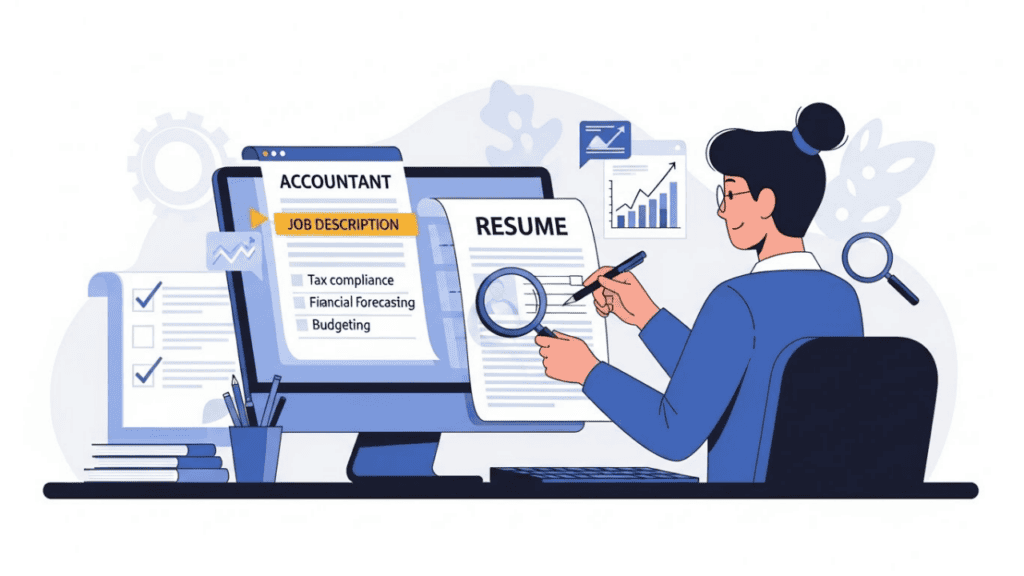
One of the biggest mistakes accountants make is submitting a one-size-fits-all resume for every job application. The truth is, each accounting position has specific needs, and tailoring your resume to match those needs can give you a competitive edge.
Here’s how to tailor your resume:
Research the Job Description 📑
Start by carefully reading the job posting. Identify the keywords and skills listed. If the job requires experience with tax compliance, financial forecasting, or budgeting, make sure these keywords appear in your resume, especially in the skills section.
Focus on Relevant Experience 💼
Highlight your experience that directly aligns with the job you’re applying for. For example, if you’re applying for a tax accountant role, emphasize your experience with tax filings, IRS compliance, and audit management. For a general ledger position, focus on reconciliation, journal entries, and balance sheet preparation.
Tailor Your Resume for Entry-Level and Senior Positions 📈
While entry-level accountants and senior accountants may share the same fundamental skills, there are distinct differences in their resumes. The level of experience and responsibility will vary, so your approach should differ based on your career stage.
Entry-Level Accountant Resume (Fresh Out of College or with Limited Experience) 🎓
For entry-level roles, the key is to focus on your education and any internships, volunteer work, or projects that demonstrate your accounting skills. Emphasize accounting principles learned during your studies, and any software you’re proficient in, like Excel, QuickBooks, or Xero.
Example:
- “Managed financial reports and provided reconciliation assistance during a 6-month internship with XYZ Accounting Firm, helping to reduce discrepancies by 15%.”
- “Completed tax filing for small clients and assisted in preparing year-end reports during internship at ABC Firm.”
Senior Accountant Resume (Experienced Professionals) 🏅
For senior positions, focus on your leadership skills, financial analysis, and complex problem-solving abilities. You’ll want to show that you can not only manage your own tasks but also lead projects, manage teams, and make strategic decisions for the company.
Example:
- “Supervised a team of 5 junior accountants, overseeing monthly closing and audit preparations for clients with revenues exceeding $5M.”
- “Developed a new budgeting system that improved accuracy by 20% and reduced the closing time by 5 days.”
✨ Make your resume shine fast!
Highlight Your Soft Skills and Certifications 🌱
In the accounting profession, soft skills are just as important as hard skills. While technical skills like knowledge of tax laws or accounting software are crucial, communication, teamwork, and problem-solving are just as valuable.
Hiring managers look for accountants who can work well with other departments, client-facing roles, and meet deadlines efficiently. Make sure to mention any relevant soft skills in your skills section or work experience section.
Additionally, your certifications play a critical role in your resume. In fact, certifications like Certified Public Accountant (CPA) or Certified Management Accountant (CMA) can give you a significant edge, especially in competitive markets. Highlight any relevant certifications, and include any ongoing education or training in the field.
Soft Skills to Highlight 🧠
- Communication: Essential for explaining complex financial data to clients and colleagues.
- Attention to Detail: Critical for accuracy in financial reporting.
- Problem-Solving: For identifying financial discrepancies and developing solutions.
Certifications to Include 🎓
- Certified Public Accountant (CPA)
- Certified Management Accountant (CMA)
- Chartered Accountant (CA)
- Certified Internal Auditor (CIA)
📝 Need a resume? Try now!
Formatting Your Resume for Maximum Impact 📑
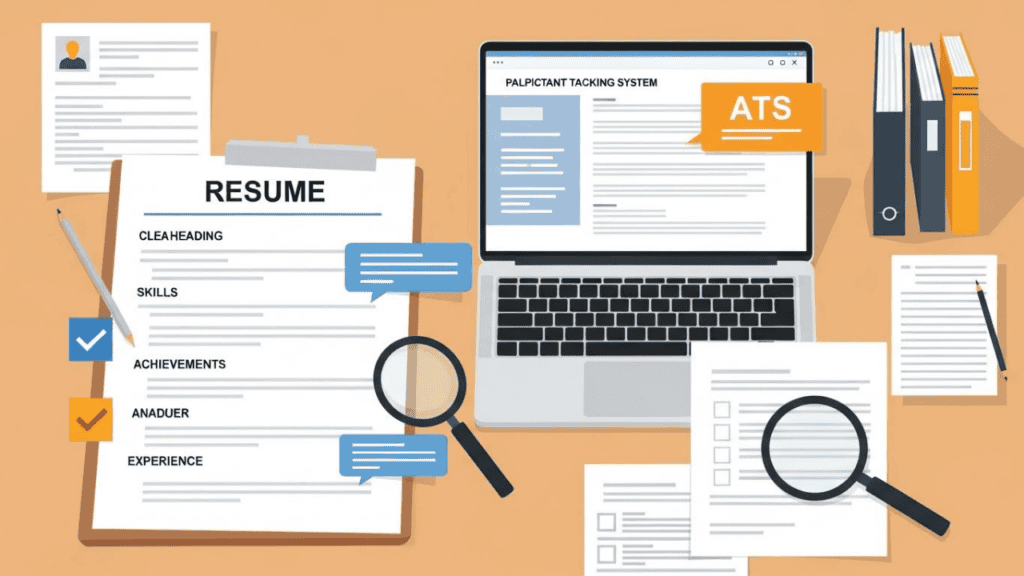
You could have all the right information on your resume, but if it’s not properly formatted, it may not get noticed. The right format will help highlight your skills and experience, making it easier for hiring managers to scan your resume quickly.
- Use Simple, Clean Formatting: Stick to standard fonts like Arial or Calibri, and use bold headers to organize sections.
- Keep It ATS-Friendly: Make sure your resume is optimized for Applicant Tracking Systems (ATS). Avoid fancy fonts or graphics, as these systems can’t read them.
- Highlight Key Sections: Use bullet points to break down key skills, achievements, and job responsibilities.
Clean formatting supports readability in all roles. The House Cleaner Job Description For Resume shows how simple layouts improve ATS performance.
Avoid Common Resume Mistakes ❌
Even experienced accountants can make resume mistakes. Here are the most common pitfalls you should avoid:
Overloading the Resume with Irrelevant Information
Focus on accounting-related experience and skills. Keep non-relevant jobs or personal information to a minimum.
Ignoring ATS Optimization
If your resume isn’t ATS-friendly, it could be overlooked. Use keywords from the job description and keep your formatting simple.
Being Too Vague
Instead of just listing tasks, quantify your achievements. Numbers are your friends—show how you saved the company money, improved efficiency, or boosted profitability.
Resume clarity is critical in operational roles. The Cashier Job Description Resume Skills & Experience highlights common mistakes to avoid.
Summary 🌟
Writing a strong accountant resume is your key to landing the job you want. By carefully tailoring your resume summary, showcasing quantifiable results in the work experience section, and highlighting the right skills, you’ll make your resume stand out to potential employers. The certifications and soft skills section can show that you’re not just proficient in numbers but also capable of communication and problem-solving. Remember to optimize for ATS, avoid irrelevant details, and follow a clear structure that highlights your achievements. With these strategies, you’ll be well on your way to securing an interview and advancing in your accounting career.
🚀 Jumpstart your career today!
FAQs: Accountant Resume Tips and Examples 🔍
Q1: How long should my accountant resume be?
- For entry-level roles, 1 page is sufficient. For senior accountants, 2 pages can be used to expand on detailed work experience and achievements.
Q2: What should I include in my skills section?
- Include both technical skills (like QuickBooks, Excel, GAAP) and soft skills (like communication, attention to detail, and teamwork).
Q3: How do I write a resume summary for an accountant?
- Your summary should briefly showcase your years of experience, core competencies (e.g., financial reporting, tax preparation), and any specializations you have.
Q4: Can I apply for an accounting job without much experience?
- Yes! Focus on your education, internships, and any volunteer work where you’ve gained relevant accounting experience.
Q5: What certifications should I list on my resume?
- List CPA (Certified Public Accountant), CMA (Certified Management Accountant), and any relevant accounting software certifications like QuickBooks Certified.
Q6: How can I tailor my resume for a specific accounting job?
- Carefully read the job description and make sure to include keywords and skills mentioned. Emphasize experience and qualifications that match the specific job requirements.
Author Information
Anny Kuratulain | Career Development Expert
Anny Kuratulain is a seasoned professional with over 9 years of experience in social media strategy, freelance coaching, and resume optimization. Specializing in helping professionals in various fields, Anny provides expert guidance on crafting resumes that stand out to hiring managers and Applicant Tracking Systems (ATS). Anny’s insights focus on empowering job seekers to highlight their key strengths, tailor resumes to job descriptions, and land the jobs they desire.

