

Key Takeaways Summary
- Highlight Dual Competencies: Successfully showcase both clinical skills (phlebotomy, vitals) and administrative proficiency (scheduling, ICD-10 coding) to prove you are a well-rounded medical assistant.
- Emphasize Certifications: Place certifications like CMA (AAMA), RMA (AMT), or BLS prominently, as these are often non-negotiable for hiring managers.
- Quantify Your Impact: Use specific numbers in your medical assistant resume description, such as “averaged 25 patient intakes daily” or “reduced wait times by 15%.”
- Tailor to the Specialty: Customize your resume based on whether you are applying for pediatrics, dermatology, or general practice, adjusting keywords to match the specific job listing.
- Optimize for ATS: Ensure your resume for a medical assistant uses standard headings and keyword-rich phrases like “electronic medical records (EMR)” to pass automated screening tools.
- Leverage Externships: For a medical assistant resume with no experience, treat your clinical externship as professional work experience, detailing hands-on procedures and patient interactions.
Introduction
The demand for skilled healthcare support is skyrocketing, and a polished medical assistant resume is your passport to top-tier clinics and hospitals. Whether you are handling front-desk administration or taking patient vitals, hiring managers need to see a balance of technical expertise and compassionate care immediately. 🏥
Writing a standout resume doesn’t have to be complicated. By focusing on the right keywords and structure, you can land more interviews.
Here is what successful candidates do differently:
- They prioritize hard skills like phlebotomy, EKG operation, and suture removal.
- They showcase soft skills like patient empathy and communication explicitly in their summary.
- They format their document to be easily readable on mobile devices and desktop screens.
- They use an eye-catching layout that remains professional and ATS-friendly.
Elena Weber, CMA
Certified Medical Assistant • Chicago, IL
Email: elena.weber.med@gmail.com • Phone: (312) 555-0199
Profile
Dedicated Certified Medical Assistant (CMA) with 5+ years of experience in high-volume clinics. Skilled in phlebotomy, taking vitals, EMR management (Epic), and assisting physicians with minor procedures. Proven track record of improving patient intake efficiency by 20% while maintaining compassionate care standards.
Experience
Senior Medical Assistant – Northside Family Practice (2021–Present)
Triaged 25+ patients daily, obtaining vitals and chief complaints with 100% accuracy. Managed vaccine inventory and administered injections. Assisted physicians with pap smears and suture removals.
Clinical Medical Assistant – City Health Urgent Care (2018–2021)
Performed EKGs, throat cultures, and urinalysis. Handled front-desk duties including insurance verification and scheduling for a 6-provider practice. Maintained strict HIPAA compliance.
Education
Associate of Applied Science in Medical Assisting – Harold Washington College (2016–2018)
High School Diploma – Lane Tech College Prep (2012–2016)
Skills
Phlebotomy • EKG Operation • Epic/Cerner EMR • Vitals Monitoring • Injection Administration • Medical Terminology • Insurance Verification • Patient Education
Certificates
Certified Medical Assistant (CMA) – AAMA (2018)
Basic Life Support (BLS) – American Heart Association (2023)
Choosing the Right Format for Your Medical Assistant Resume
When crafting a resume for a medical assistant, the structure is just as important as the content. Hiring managers and doctors are busy; they spend an average of six seconds scanning a resume. You need a format that delivers your qualifications instantly.
For 90% of candidates, the reverse-chronological format is the gold standard. This layout lists your most recent work experience first and works backward. It is preferred because it shows your current career level and recent clinical practice immediately. 📅
If you are writing a medical assistant resume with no experience, consider a functional or hybrid format. This shifts the focus away from employment dates and highlights your externships, education, and specific medical assistant resume skills acquired during training.
Header and Contact Information
Keep this section clean. Include your full name, phone number, professional email, and city/state. You can also include a link to your LinkedIn profile if it is up to date. Avoid adding full street addresses for privacy reasons. Ensure your email address sounds professional (e.g., firstname.lastname@email.com rather than nurse_babe99@email.com).
Writing a Compelling Professional Summary
Your summary is your elevator pitch. It sits at the top of the page and acts as a hook. A generic objective statement like “Looking for a job in healthcare” is outdated. Instead, write a summary that highlights your certification, years of experience, and key strengths.
Example of a strong summary:
“Reliable Certified Medical Assistant (AAMA) with 4 years of experience in pediatric and internal medicine. Proficient in EMR software (Epic), phlebotomy, and immunization administration. Committed to streamlining patient flow and ensuring high-quality patient care in fast-paced clinic environments.”
This paragraph immediately answers who you are, what you can do, and the value you bring, incorporating vital keywords like “Certified Medical Assistant” and “EMR software.”

Essential Medical Assistant Resume Skills
The skills section is the heart of your document. Because this role is a hybrid of clinical and clerical work, your medical assistant resume skills section must reflect both sides. 💊

Clinical Skills (Hard Skills)
These are the technical abilities you learned during your training. Be specific.
- Phlebotomy & Specimen Collection: Mention if you are comfortable with difficult sticks or pediatric patients.
- Vital Signs: Blood pressure, pulse, respiration, temperature, and BMI calculation.
- Injections & Immunizations: Specify if you handle IM, SQ, or ID injections.
- EKG/ECG: Setup and monitoring.
- Assisting in Minor Surgery: Suture removal, tray setup, and sterilization (autoclave).
- Lab Testing: Urinalysis, rapid strep tests, pregnancy tests, and glucose checks.
Administrative Skills
Don’t neglect the front office. Many clinics require MAs to cover the desk.
- EMR/EHR Systems: List specific software like Epic, Cerner, Meditech, or AthenaHealth.
- Scheduling: Triage and appointment management.
- Medical Billing/Coding: Basic knowledge of ICD-10 and CPT codes.
- Insurance Verification: Pre-authorization and co-pay collection.
- HIPAA Compliance: Understanding patient privacy laws is crucial.
Structuring Your Experience Section
When writing your medical assistant resume description for work history, avoid simply listing duties. Instead, focus on achievements and quantify your results whenever possible. Numbers pop off the page and give credibility to your claims.
Weak description:
“Took vitals and answered phones. Helped the doctor with procedures.”
Strong description:
“Recorded vital signs and medical history for an average of 30 patients per shift with 100% accuracy. Assisted physicians with minor surgical procedures including mole removals and laceration repairs. Reduced patient wait times by 15% by reorganizing the intake filing system.”

Using Action Verbs
Start every bullet point with a strong action verb. Good examples for a resume of medical assistant include: Administered, Triaged, Sterilized, Documented, Educated, Coordinated, and Processed. This makes you sound proactive rather than passive.
Education and Certifications
Education is a critical verification step in healthcare. List your degree or diploma, the name of the institution, and the year of graduation. If you have a high GPA (3.5 or above), feel free to include it, especially if you are new to the field.
Certifications Matter
In many states, certification is not legally required but is highly preferred by employers. If you have them, list them prominently, perhaps even in a dedicated section or next to your name in the header.
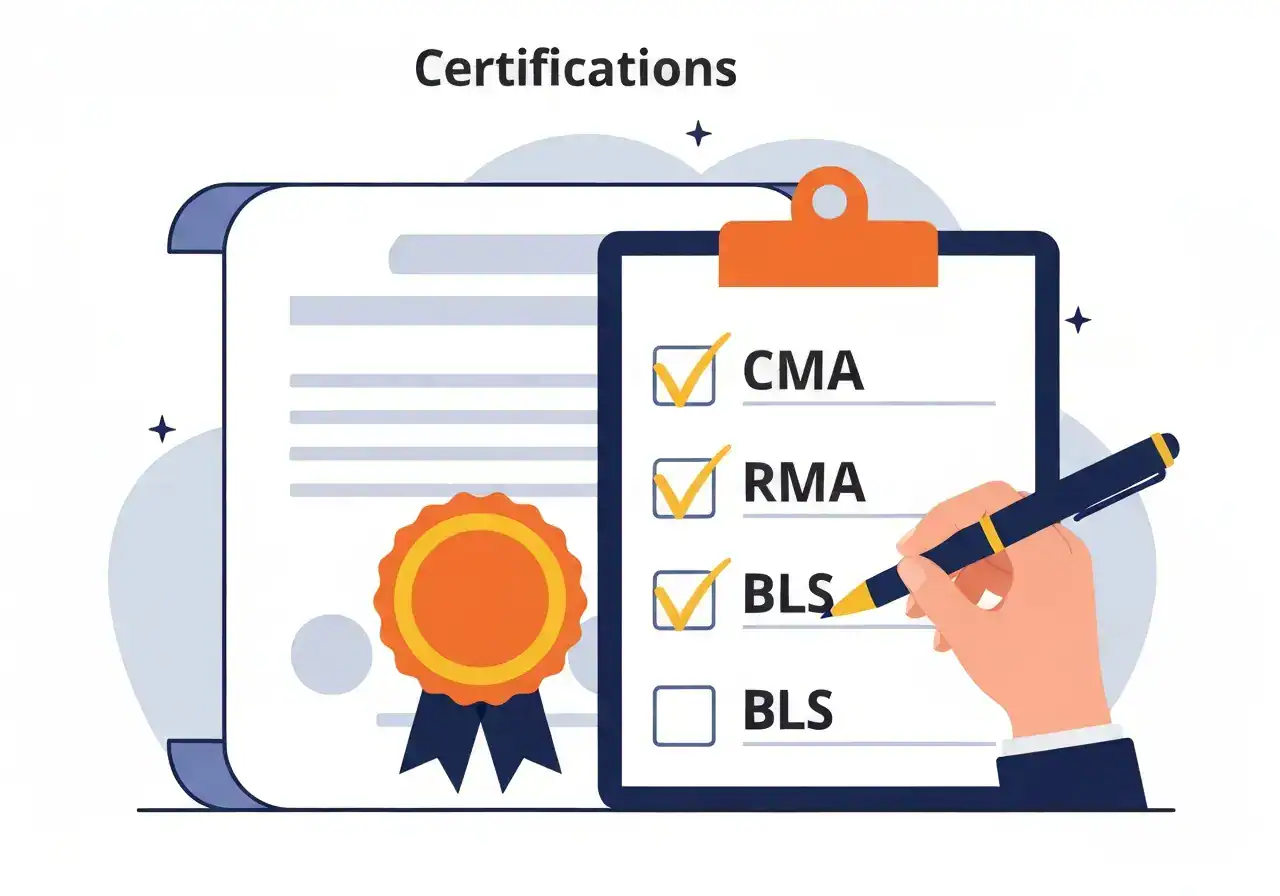
- CMA (AAMA): Certified Medical Assistant
- RMA (AMT): Registered Medical Assistant
- CCMA (NHA): Certified Clinical Medical Assistant
- NCMA (NCCT): National Certified Medical Assistant
- BLS/CPR: Basic Life Support (usually required by AHA or Red Cross)
Tips for a Medical Assistant Resume with No Experience
Everyone starts somewhere. If you are looking for resume examples for medical assistant entry-level roles, focus heavily on your externship. Treat your clinical externship as a job. List the name of the facility, the dates, and the specific tasks you performed.
Externship Example:
Clinical Extern | General Hospital Outpatient Center
“Completed 160 hours of clinical rotation. Performed 50+ successful venipunctures. Observed and assisted in wound care dressing changes. Mastered patient intake protocols using AthenaHealth EMR.”
Additionally, highlight transferable skills from previous non-medical jobs. Customer service experience (retail, food service) is highly valuable because it proves you can handle difficult people, multitask, and maintain a friendly demeanor—all essential for patient care.
Common Mistakes to Avoid
Even qualified candidates get rejected due to simple errors. Ensure your medical assistant resume is free of these pitfalls:
- Typos: In the medical field, a small error can be dangerous. A typo on your resume suggests a lack of attention to detail.
- Cluttered Layout: Leave enough white space. Walls of text are hard to read.
- Outdated Information: Remove high school details if you have a college degree and 5+ years of experience.
- Generic Content: Tailor your resume to the job description. If the ad mentions “pediatrics,” highlight your experience with children.
FAQ: Medical Assistant Resume
1. Should I include a cover letter with my medical assistant resume?
Yes, absolutely. While some hiring managers might skip it, others consider it essential. A cover letter allows you to explain gaps in employment, express your passion for patient care, and mention specific reasons why you want to work for that particular clinic or hospital. It adds a personal touch that a bulleted resume cannot convey.
2. How do I get my resume past the ATS (Applicant Tracking System)?
To beat the ATS, use standard headings (like “Experience” and “Education”) and incorporate keywords found in the job description. Common keywords include “HIPAA,” “phlebotomy,” “vital signs,” and specific EMR names. Avoid using graphics, columns, or fancy fonts that the software might not be able to read.

3. How long should a resume for a medical assistant be?
For most medical assistants, a one-page resume is ideal. If you have more than 10 years of experience, two pages are acceptable, but keep the most relevant information on the first page. Be concise and prioritize recent, relevant experience over older, unrelated jobs.
4. Do I need to list my high school if I have a certificate?
If you have completed a post-secondary medical assisting program or have an associate degree, you generally do not need to list your high school diploma. However, if the job posting specifically asks for a high school diploma or equivalent as a minimum requirement, it is safe to include it to ensure you meet the criteria.
5. What is the difference between a CV and a resume for this role?
In the US, a resume is a concise document (1-2 pages) used for job applications, while a CV (Curriculum Vitae) is a longer, detailed document used for academic or research roles. For 99% of medical assistant jobs, you should submit a resume, not a CV. Keep it focused on skills and work history relevant to the clinic.
Author Information
Rebecca Lawson – Lead Resume & ATS Specialist
Rebecca Lawson is the Lead Resume & ATS Specialist at ResumeAITools, with 10+ years of experience helping job seekers across all industries improve their resumes and land better roles. With a Fortune 500 HR background, she understands exactly how ATS systems filter applicants and what hiring managers look for. Rebecca specializes in healthcare and administrative resumes, ensuring candidates highlight the precise clinical and soft skills needed to secure interviews in the competitive medical field.
