

Key Takeaways
- Choose weaknesses that are real, job-safe, and manageable, not role-breaking.
- Always explain what you’re doing to improve, not just the weakness itself.
- Keep weakness answers short, structured, and calm (30–45 seconds).
- Avoid red-flag weaknesses that suggest poor attitude, dishonesty, or unreliability.
- In Australian interviews, clarity and self-awareness matter more than sounding perfect.
Introduction
In Australian job interviews, the “strengths and weaknesses” part is a fast test of self-awareness and communication. Common Weaknesses In Job Interviews In Australia (with examples) are not “bad traits” you must hide. They are the weak points you can explain clearly, support with a real example, and show you are improving.
Most job seekers get stuck on one question: what is your greatest weakness. The best approach is simple. Pick a weakness that does not break the role, show the steps you take to manage it, and give a short example with a result. That is how you handle the what is your weak point interview question without sounding fake.
Michael Turner
Job Seeker • Sydney, NSW • Australia
Email: michael.turner.interview@gmail.com • Phone: +61 427 951 638
Why Interviewers Ask About Weaknesses
Australian interviewers ask about weaknesses to assess self-awareness, honesty, and willingness to improve. They are not looking for perfection, but for realistic and well-managed areas of development.
Common Interview Weaknesses (Australia)
• Being too detail-focused
• Difficulty delegating tasks
• Nervousness when speaking in public
• Taking on too much work at once
• Limited experience with a specific tool or system
• Overthinking decisions
Good Weakness Examples (With Smart Framing)
Example 1:
“I can be too detail-oriented at times, so I’ve learned to prioritise tasks and set time limits
to stay efficient.”
Example 2:
“Earlier in my career, I found it difficult to delegate, but I’ve improved by trusting team
members and communicating expectations clearly.”
Example 3:
“I used to feel nervous presenting to groups, so I’ve actively worked on this by volunteering
for meetings and presentations.”
Weaknesses to Avoid Mentioning
❌ Poor time management
❌ Lack of motivation
❌ Difficulty working with others
❌ Being unreliable or frequently late
❌ Anything critical to the role you’re applying for
How to Answer This Question Correctly
Use this simple structure preferred in Australian interviews:
1. Name a real but safe weakness
2. Explain how it affected you
3. Show what you are doing to improve
Safe Example Answer (Australia)
“One area I’ve been working on is being overly detail-focused. I’ve learned to balance accuracy with efficiency by prioritising tasks and setting clear deadlines, which has improved my overall productivity.”
🚀 Create your resume quickly and for free!
Understanding the Question: Why Do Employers Ask About Strengths and Weaknesses?
Employers ask because they want proof you can reflect, learn, and work well with others. In Australia, that usually means a calm answer, clear English, and a practical improvement story. The employer is not asking for a perfect person. The employer is checking if your answer matches your past behaviour.
This also links to the wider hiring process. Recruiters often compare your interview answers with your resume and Applicant Tracking Systems (ATS) scans. A resume may show results and keywords. The interview checks if you can explain how you got those results.
In Australia, you may also hear workplace topics like wellbeing, work-life balance, and the right to disconnect. Employers do not expect you to be flawless. Employers want you to be honest and stable under pressure.
How to Identify Your Strengths
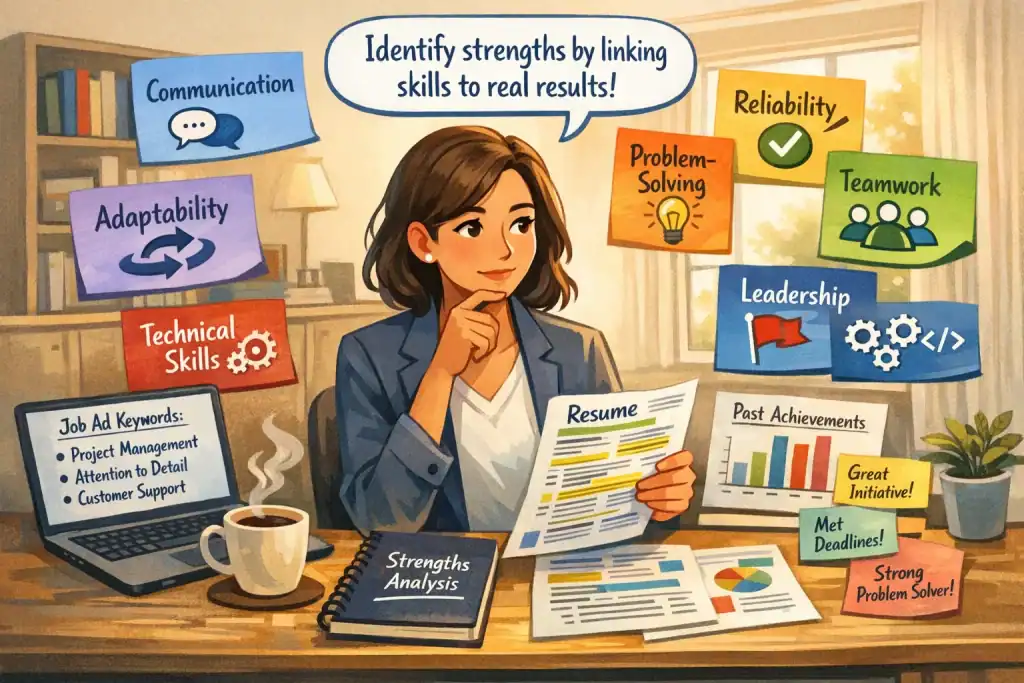
Start with facts. A strength is a skill or habit you can prove with outcomes, feedback, or examples. I like to build a short list of strong points first, then pick the ones that match the role.
Use three sources:
- Job ad keywords (skills, tools, traits)
- Proof from past work (numbers, outcomes, customer feedback)
- Feedback (manager notes, performance reviews, peer comments)
If you are unsure where to start, take your resume, highlight strong results, and ask: “What skill made this result happen?” That’s your strength.
Examples of Strengths in the Workplace
Here are workplace strengths that land well in Australia, when you can prove them:
- Communication skills (clear updates, good written notes, strong stakeholder communication)
- Problem-solving skills (fixing issues, preventing repeat problems)
- Reliability (showing up, meeting deadlines, consistent quality)
- Teamwork (multicultural team dynamics, cross-team coordination)
- Adaptability (handling change, learning tools, shifting priorities)
- Leadership (coaching, delegation, decisions)
- Technical skills (systems, software, engineering tools, compliance knowledge)
If you want to align this with your resume later, use your own “skills to put on resume” list and keep the wording consistent.
How to Articulate Strengths Using the STAR Method
Use the Situation, Task, Action, Result (STAR) method. Keep it short. Australian interviews often reward clarity over long stories.
- Situation: Where were you?
- Task: What was the goal or problem?
- Action: What did you do?
- Result: What changed?
Example (short STAR):
- Situation: “Our team had a reporting backlog.”
- Task: “I needed to improve turnaround time.”
- Action: “I rebuilt the template and set a weekly check routine.”
- Result: “Reports went out on time and errors dropped.”
5 Sample Responses to “What Are Your Strengths?”
- Communication
“My strength is communication. I keep updates short, confirm actions, and follow up. In my last role, this reduced rework because everyone knew the next step.” - Problem-solving skills
“My strength is problem-solving skills. I spot the root cause, test a fix, and document it. I used that approach to reduce repeat issues in a busy operations team.” - Reliability
“My strength is reliability. I plan my work early, meet deadlines, and keep quality steady. My manager trusted me with urgent tasks because I did not miss key dates.” - Teamwork
“My strength is teamwork. I work well across different personalities and I keep communication respectful. This helped in a multicultural team where clear handovers mattered.” - Technical focus
“My strength is technical focus. I learn systems fast and I apply them carefully. I improved reporting accuracy by standardising how data was entered and checked.”
🚀 Create your resume quickly and for free!
How to Navigate Your Weaknesses
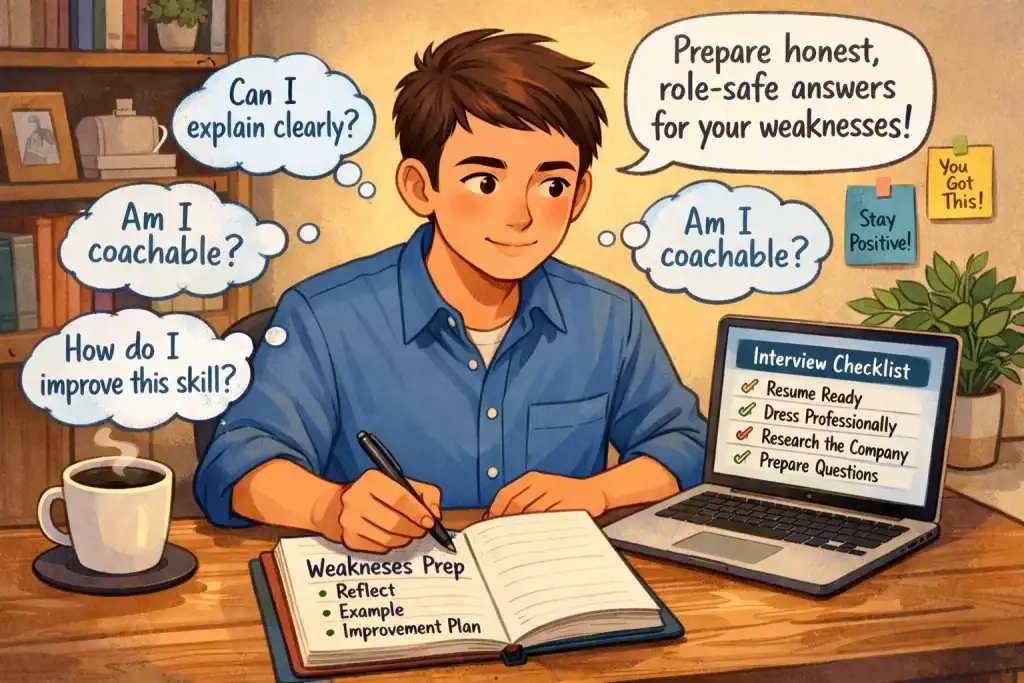
A good weakness answer is honest, role-safe, and improvement-focused. The goal is not to “win” by being clever. The goal is to show you can manage your weaknesses at work.
Many people search weaknesses in job interview because they fear the wrong answer will cost them the role. That fear is normal. The fix is preparation.
What is the Interviewer Really Asking?
The interviewer is asking:
- Can you reflect without blaming others?
- Can you explain a work issue clearly?
- Do you learn and adjust?
- Will you be safe, stable, and coachable?
That is why “I have no weaknesses” fails. That is also why overly negative answers fail. The interviewer does not want a personal breakdown. The interviewer wants a work story.
Be Prepared to Discuss Your Weaknesses
Pick one main weakness. Prepare one short example. Prepare one improvement plan. That is enough for most interviews.
A quick warning: if you talk too long, the answer feels rehearsed or defensive. A 30–45 second answer is a safe target.
Also, do not confuse honesty with oversharing. A weakness is a work habit that you are improving, not a deep personal issue.
Strategies for Answering “What Is Your Weakness?”
Use this simple structure:
- State the weakness in one line
- Give a real example (short)
- Explain how you address it now
- End with the result
This structure works for:
- what is your weakness job interview question
- how to answer what is your biggest weakness interview question
- how do you answer an interview question about your weaknesses
Put Your Weaknesses in a Positive Light
This does not mean you fake it. It means you show control and growth.
Bad style:
“I’m terrible with time and I always mess up.”
Better style:
“I used to underestimate timelines. Now I plan work in blocks and confirm priorities early.”
Give Concrete Examples of Lessons Learned
A lesson learned should be specific:
- “I started asking for priorities on day one of the week.”
- “I now set a deadline check 48 hours before final delivery.”
- “I took a short course on Coursera to fill the gap.”
If your weakness is related to communication or confidence, you can show small, steady practice. Employers trust consistent action more than big promises.
Show How You’re Addressing Your Weaknesses
Your improvement plan can include:
- a habit (weekly planning, daily checklists)
- a tool (calendar blocks, task boards)
- training (online course, coaching)
- feedback (regular check-ins)
This is how you turn personal weaknesses into a professional answer.
Examples of Weaknesses in the Workplace
Here are common workplace weaknesses that show up in Australia:
- over-focusing on details
- difficulty saying no
- trouble delegating
- reluctance to ask for help
- nerves speaking up
- time management under pressure
- avoiding conflict
- limited experience in a tool (non-core)
These match what people search as weaknesses examples, personal weaknesses examples, and job interview flaws.
Strong Weakness Examples
A strong weakness answer has three traits:
- It is not a core requirement of the role
- It is easy to improve
- It has a clear story with a result
Examples:
- “I used to take on too much. Now I confirm priorities and deadlines before accepting extra tasks.”
- “I used to avoid speaking up in meetings. Now I prepare one point in advance and share it early.”
5 Sample Responses to “What Are Your Weaknesses?”
- Detail focus affecting speed
“My weakness was spending too long perfecting small details. I now set a time limit for first drafts and do a final check later. This improved turnaround time without hurting quality.” - Saying yes too quickly
“My weakness was saying yes to extra tasks too fast. I now ask what the top priority is and confirm timelines before I commit. This reduced overload and kept delivery steady.” - Asking for help late
“My weakness was trying to solve everything alone. I now raise issues early and ask for support when needed. That improved outcomes and reduced delays.” - Delegation
“My weakness was delegating too little. I now break tasks into clear parts and confirm expectations. This helped the team move faster and reduced bottlenecks.” - Speaking up
“My weakness was hesitating to speak up in group settings. I now prepare a short point and ask a direct question. This improved clarity and reduced confusion.”
🚀 Create your resume quickly and for free!
Examples of Good Weaknesses to Use in an Interview
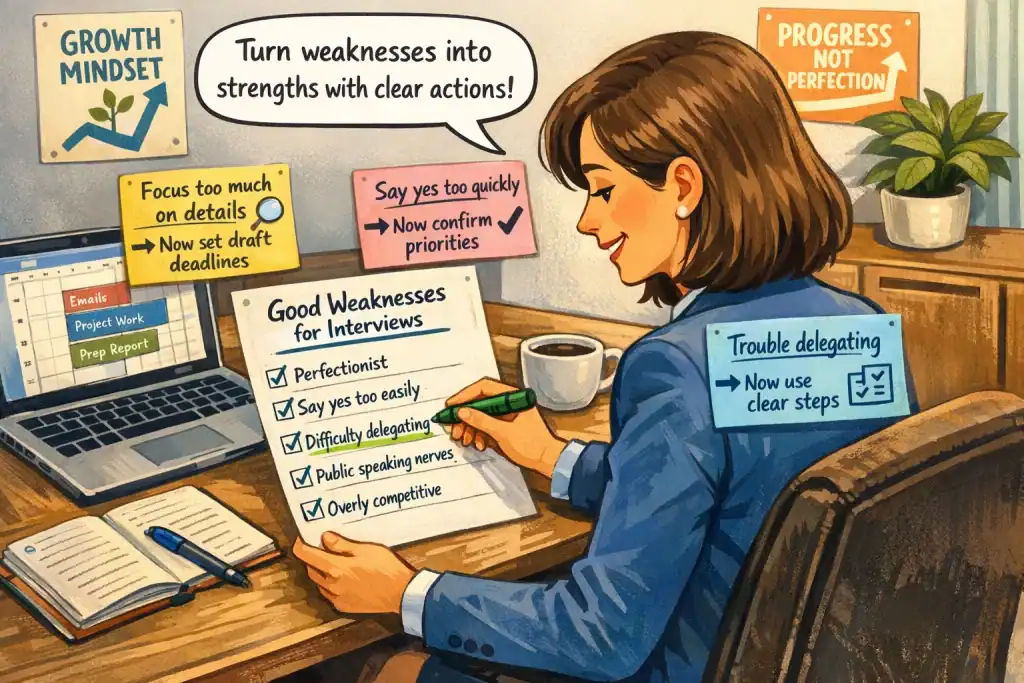
Below are common answers people use in Australia. I’m including a short, clean example for each. You can adapt the wording to your role.
I sometimes miss deadlines because I focus too much on details
Good answer (short):
“I used to spend too long polishing details, and that could push timelines. I now set draft deadlines, use a checklist, and confirm priorities early. This keeps quality high and deadlines steady.”
I have trouble saying “no”
Good answer (short):
“I used to say yes too quickly and take on too much. I now ask what the priority is and confirm deadlines before I commit. That helps me support the team without overloading work.”
I get distracted easily with other projects
Good answer (short):
“I used to switch tasks too often when new requests came in. I now block time in my calendar and group similar tasks. That improved focus and reduced rework.”
I don’t have much experience in this skill, but I’m learning along the way
Good answer (short):
“I have limited experience with one part of the toolset, but I started training and practice tasks to close the gap. I can already handle the basics and I keep building capability week by week.”
I have trouble delegating work
Good answer (short):
“I used to hold onto tasks because I wanted control over quality. I now delegate with clear steps and check points. This helps the team move faster and keeps standards consistent.”
I have trouble working with certain personalities
Good answer (short):
“I used to struggle when communication styles clashed. I now focus on clear expectations, written follow-ups, and respectful boundaries. That improves teamwork and reduces friction.”
My biggest weakness is maintaining a healthy work-life balance
Good answer (short):
“My weakness was letting work spill into personal time. I now plan tasks earlier, set boundaries, and use wellbeing strategies so I stay consistent and productive at work.”
My biggest weakness is that I’m a perfectionist who can’t let go
Good answer (short):
“I used to over-edit and delay delivery. I now aim for ‘ready and correct,’ then refine if needed. This improved speed without reducing quality.”
My biggest weakness is that I can’t find it within myself to ask for help
Good answer (short):
“I used to wait too long before raising issues. I now ask earlier when a task risks timelines. This prevents delays and helps the team solve problems faster.”
My biggest weakness is that I become unorganised when I have too much going on
Good answer (short):
“When workload spikes, I can lose structure. I now use a task board, confirm priorities daily, and block time for high-impact work. This keeps delivery stable.”
My biggest weakness is that I am afraid to speak up
Good answer (short):
“I used to stay quiet in meetings. I now prepare one point and one question before the meeting. That helps me contribute clearly and build confidence.”
My biggest weakness is that I shy away from unfamiliar situations because I lack confidence
Good answer (short):
“I used to avoid unfamiliar tasks early on. I now break new tasks into steps, ask for quick guidance, and practice. That builds confidence and improves learning speed.”
What Not to Say When Asked “What Is Your Greatest Weakness?”
This section matters because many people search what is your greatest weakness answer and copy the wrong style.
Don’t Say You Don’t Have Any Weaknesses
That answer sounds defensive or unaware. Everyone has a weakness. Employers want honesty.
Don’t Frame a Positive Trait as a Negative One
“Perfectionism” can work only if you show a real downside and a real fix. If it sounds like a humble brag, it fails.
Don’t Mention Too Many Weaknesses
Pick one. Two is the max, if the interviewer asks for more. Keep control of the message.
Don’t Forget to Show How You’re Improving
A weakness without an improvement plan sounds risky. Even a simple plan is enough.
How to Communicate Your Weakness in a Positive Way
Use a calm tone. Keep the weakness work-related. Show growth. End with the result.
If you want to test your wording, ask: “Would this answer make an employer feel safe hiring me?” If the answer is yes, you’re on track.
Also, watch your language. People often type “weakness weakness” when they feel stuck. The fix is structure and practice, not more overthinking.
How to Structure Your Answer to Bring It All Together
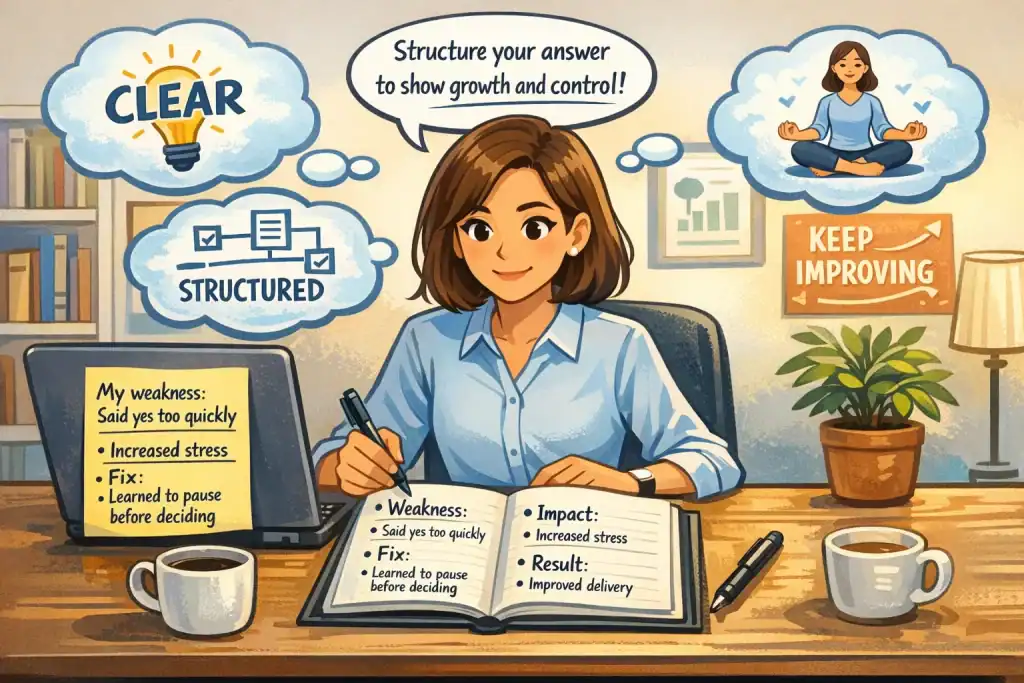
Here is my go-to structure for the what are your weaknesses answers question:
- Weakness: one line
- Impact: one line
- Fix: one or two actions
- Result: one line
Example:
“My weakness was saying yes too quickly. That created overload at busy times. I now confirm priorities and deadlines before I commit. This improved delivery and reduced stress.”
This structure also works for what are your biggest weaknesses, what are your main weaknesses, and weakness of a person job interview questions.
How to Answer the Weakness Question with Confidence
Confidence comes from preparation, not personality. Practice out loud. Record your answer once. Cut anything that sounds like an apology loop.
Use clear English. Avoid long explanations. In Australia, direct answers land well.
If you struggle with interview confidence, treat this like a script you can refine. You do not need to sound perfect. You need to sound real and stable.
Nuances for Different Career Stages
New Graduates
Good graduate weaknesses are usually about experience and confidence, not attitude:
- limited exposure to a tool (non-core)
- speaking up in meetings
- time estimates on new tasks
Graduate tip: connect your weakness to learning steps. Mention training, practice, and feedback.
If you are also job hunting with no experience, you may be reading “online jobs no experience.” That same strategy applies here: show learning, show effort, show proof.
Mid-Career Professionals
Mid-career answers should show ownership and systems:
- delegation
- prioritising across projects
- stakeholder communication style
Mid-career tip: show how you improved with routines, tools, and feedback.
Senior Professionals
Senior answers must avoid role-breaking weaknesses. Focus on leadership habits:
- delegating earlier
- adjusting communication for different teams
- balancing speed and quality
Senior tip: show you coach others, not just yourself. Show you build a process.
This is also where industry context can appear. In WA mining, EPCM and EPC projects move fast. In power systems, safety and compliance matter. In engineering culture, clarity and handovers matter. Keep your weakness away from safety and ethics.
Common Pitfalls to Avoid
These are common interview mistakes in Australia:
- talking too long
- choosing a weakness that breaks the job
- blaming others
- sounding scripted
- skipping the improvement plan
- using vague phrases like “I’m just not good with people”
If you are interviewing through a recruitment agency or Recruitment Australia style process, the recruiter may screen you first. Recruiters often listen for clarity, coachability, and fit.
Also, keep cultural awareness. If you work in areas connected with First Nations, Indigenous People, or Indigenous employment initiatives, show respect and practical awareness. Do not fake knowledge. Keep it real.
Turn Your Weaknesses into Strengths
This is the safest way to frame the topic:
- A weakness is a skill gap or habit you manage.
- A strength is a skill you can repeat with results.
When you show you can address your weaknesses, you show employability. Employers like candidates who can learn, adjust, and stay steady in today’s economy.
Work-life balance can be a good example when you handle it well. Employers often prefer stable routines over burnout cycles. Mention wellbeing strategies and boundaries, not dramatic stories.
Tips
Use these 7 tips in Australian job interviews:
- Answer in 30–45 seconds
- Pick a role-safe weakness
- Use one real example
- Show the fix
- End with the result
- Keep the tone calm
- Match your resume language
If you are building your resume alongside interview prep, check your internal guides:
- skills to put on resume
- how many pages should a resume be
- how long should a resume be
- what is a cv
- is a cv a resume
🚀 Create your resume quickly and for free!
Summary
Common weaknesses in job interviews in Australia are not meant to trap candidates but to test self-awareness, communication, and growth. The best answers focus on a genuine weakness that does not affect core job requirements, followed by clear actions taken to improve and a positive outcome. By keeping answers practical, honest, and aligned with Australian workplace culture, job seekers can turn a difficult question into a strong signal of maturity and employability.
FAQs
What are 5 examples of weaknesses in an interview?
Five safe examples are over-focusing on details, difficulty delegating, saying yes too often, hesitating to ask for help, and nervousness speaking up in groups.
What is your 3 weaknesses’ best answer?
A strong answer lists three job-safe weaknesses briefly, then explains how each is being managed or improved with habits, tools, or feedback.
What are 5 examples of weaknesses of a person?
Common examples include overthinking, impatience, lack of confidence in new situations, difficulty setting boundaries, and struggling with time management under pressure.
What weaknesses are red flags in an interview?
Red flags include dishonesty, poor reliability, negative attitude, inability to accept feedback, poor teamwork, or blaming others for mistakes.
What is your weakness’ best answer: overthinking?
A good answer is: “I tend to overthink decisions, but I now set time limits, seek quick feedback, and focus on action. This helps me make decisions faster without losing accuracy.”
Author Information
Anny Kuratulain | Career Development Expert
Anny Kuratulain is a seasoned professional with over 9 years of experience in social media strategy, freelance coaching, and resume optimization. Specializing in helping professionals in various fields, Anny provides expert guidance on crafting resumes that stand out to hiring managers and Applicant Tracking Systems (ATS). Anny’s insights focus on empowering job seekers to highlight their key strengths, tailor resumes to job descriptions, and land the jobs they desire.
