

Key Takeaways
-
Match the job with 2–3 role keywords, then prove them with one example.
-
Keep your answer to 30–60 seconds unless asked for more.
-
Use “value + evidence + fit” instead of personal need.
-
Freshers can use projects, volunteering, and transferable skills.
-
Your answer should match your resume and ATS (Applicant Tracking Systems (ATS)) keywords.
Introduction
If you searched Why Should We Hire You Answer Examples Australia, you probably want two things: words you can actually say, and a structure that keeps you calm when your brain goes blank.
In Australia, this question is rarely about who is “the best person in the world.” Hiring managers want a clear reason you will perform, fit, and stick around. They want proof, not hype.
Thomas Reed
Job Seeker • Melbourne, VIC • Australia
Email: thomas.reed.interview@gmail.com • Phone: +61 421 936 508
What Australian Employers Want to Hear
In Australia, interviewers look for clear, practical answers. They want to know if you can do the job, fit the team culture, and add value without over-selling yourself.
Simple Structure That Works
A strong answer usually includes:
• One key strength relevant to the role
• A short example or result
• How this benefits the employer
Answer Example – Customer Service (Australia)
“You should hire me because I’m reliable and customer-focused. In my previous role, I handled high-volume customer enquiries while maintaining positive feedback. I’m confident I can deliver the same level of service and support your team during busy periods.”
Answer Example – Administrative / Office Role
“You should hire me because I’m organised and detail-oriented, with experience supporting busy teams. I’ve managed documentation, scheduling, and internal communication, helping operations run smoothly and efficiently.”
Answer Example – Entry-Level / Graduate
“You should hire me because I bring a strong work ethic, a positive attitude, and a willingness to learn. I’m reliable, open to feedback, and motivated to grow while contributing to the team.”
Answer Example – Retail / Hospitality
“You should hire me because I’m approachable, dependable, and comfortable working in fast-paced environments. I’m flexible with shifts and focused on delivering friendly, consistent customer service.”
Common Mistakes to Avoid
❌ Sounding arrogant or overly confident
❌ Giving vague answers without examples
❌ Saying “because I need the job”
❌ Repeating your resume word-for-word
Safe Short Answer (Australia)
“You should hire me because I’m reliable, motivated, and bring a strong work ethic. I adapt quickly and focus on delivering consistent results.”
🚀 Create your resume quickly and for free!
Understanding the Questions
Why Employers Ask These Questions
When an interviewer asks why should we hire you, they are checking three things fast:
-
Can you do the work well?
-
Will you work well with the team?
-
Are you a safe bet in terms of reliability, communication, and follow-through?
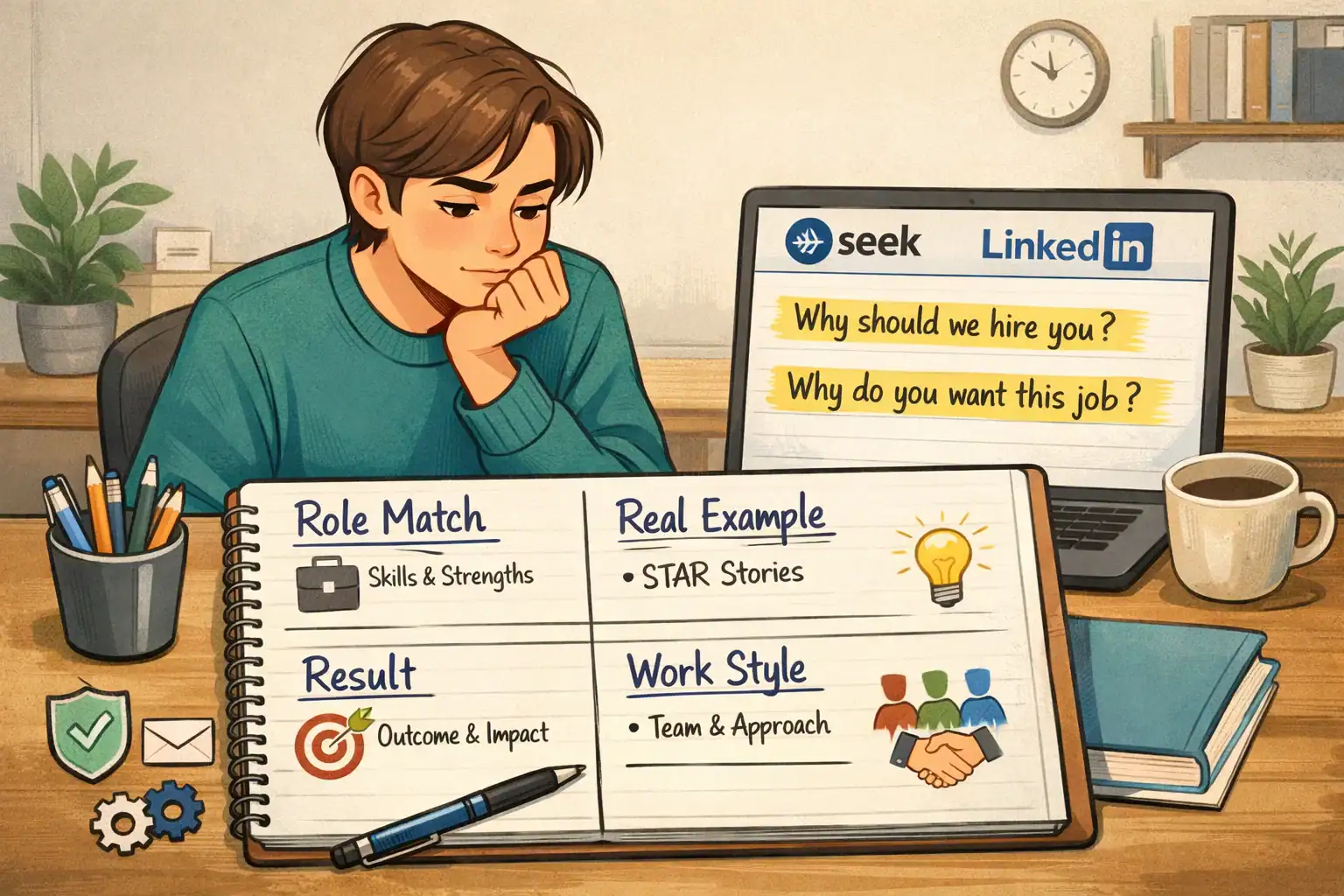
Australian employers often hire through SEEK, Seek Australia, LinkedIn, or a recruitment agency. Many use screening calls first, then a panel. In both cases, this question helps them compare candidates quickly.
You might also hear the same question in different words: why should i hire you, or why should we hire you over other candidates. It is still the same test. They want your clearest value case.
You Can Also Read what is a cv
Identifying What Interviewers Want to Hear
Most people try to impress with “I’m hardworking.” That does not separate you. The answer that separates you is:
-
a role match (skills they asked for)
-
a real example (what you did)
-
a result (what improved)
-
a work style that fits the team (reliability, communication, flexibility)
Think of it as your mini “USP” (Unique Selling Proposition (USP)). It should sound like you understand their problems and can help fix them.
What Interviewers Want to Hear for ‘Why Do You Want This Job?’
This question shows up as why do you want this job or why do you want this position. Sometimes it comes first. Sometimes it comes right after why should we hire you interview question.
The interviewer is listening for four things.
How much you know about the company
They do not need a history lesson. They want signs you did basic research and you understand what the business does. If it’s a listed company, you might mention a product line. If it’s a local employer, you might mention the customer base or locations.
If you want a simple line that works in Australia:
“I looked at your services and your customer focus. The role makes sense for my skills, and the work style fits how i like to operate.”
How the role fits your career plan
This is where people mess up by sounding like they will leave in six months.
Avoid: “This will be a good stepping stone.”
Say: “This role fits my next step in [field], and i want to build depth in these responsibilities.”
How you bring value to the role
Link your background to their needs. Show a practical connection. Hiring managers in Australia like concise proof.
This is where you link your resume keywords and your interview answer. If your resume says “stakeholder engagement specialist” or “continuous improvement champion,” your answer should show what you did, not just the label.
Why the company appeals to you
Use one real reason. Keep it calm.
This is a good place to address why do you want to work for us without sounding like you are begging. You can also let the company know about your interest working there by naming one thing that genuinely fits you: learning opportunities, team structure, customer impact, stable roster, project type, Australian market exposure.
You Can Also Read how long should a resume be
🚀 Create your resume quickly and for free!
Preparing Your Answers
Step 1: Research and Understand
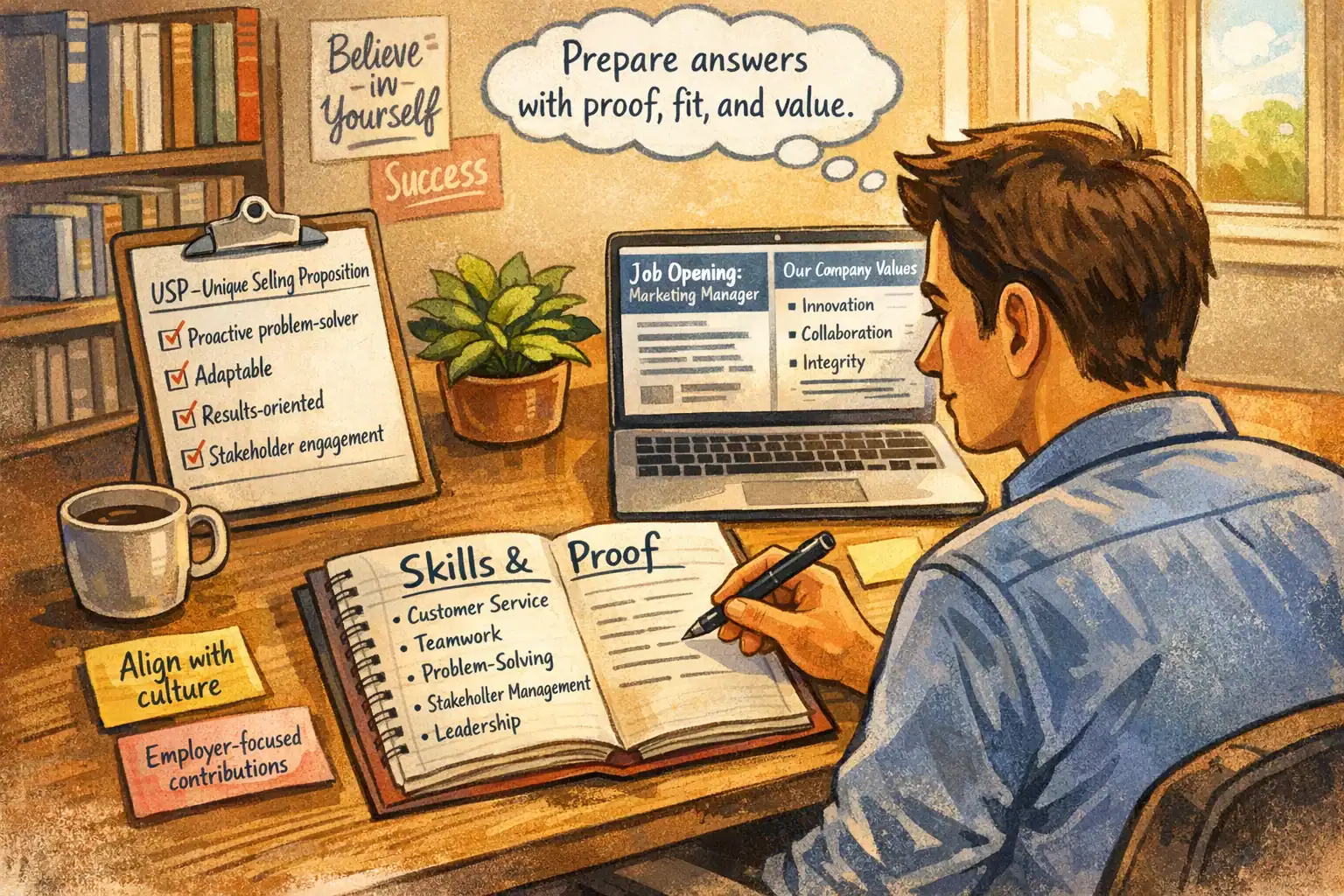
Good answers are built before the interview. In Australia, the job ad language is your cheat sheet. Pull 5–10 keywords and mirror them naturally.
Company Philosophy and Culture
Look for clues: values page, Glassdoor Australia reviews, LinkedIn posts, and how they talk about customers. You do not need to agree with everything. You want to show alignment where it’s real.
A simple phrase that signals fit without fluff:
“I like a practical environment with clear expectations, honest feedback, and teamwork.”
That is “Data-driven cultural alignment” in plain English.
Understand the Job Description
Read it like a checklist. What do they repeat?
-
customer service
-
compliance
-
reporting
-
stakeholder management
-
problem-solving
-
time management
-
teamwork
-
flexibility
-
leadership
These become your answer backbone for why should we hire you 3 points or why should we hire you 5 points.
Understand the company’s mission and core values
If they mention service, safety, accuracy, growth, or wellbeing, use one of those words in your answer, then connect it to proof.
Example:
“You emphasise quality and accountability. That matches how i work. I track details, hit deadlines, and flag issues early.”
Step 2: Assess Your Skills and Experience
Do a quick skills inventory. Split it into:
-
hard skills (tools, systems, technical work)
-
soft skills (communication skills, teamwork, problem-solving skills)
-
proof (metrics, outcomes, feedback, awards)
If you are a fresher, use:
-
placements
-
part-time work
-
volunteering
-
uni projects
-
online courses (Coursera can count if you can explain what you built)
You are not trying to sound perfect. You are trying to sound useful.
You Can Also Read chat gpt cover letter
Step 3: Develop a Unique Selling Proposition (USP)
Your USP is not “i’m passionate.” Your USP is what you do that reduces risk for the employer.
Examples of strong, Australia-friendly USP angles:
-
Proactive problem-solving mindset: “i spot issues early and fix them before they become a bigger problem.”
-
Adaptable cross-functional collaborator: “i can work with different teams and keep things moving.”
-
Results-oriented project delivery: “i don’t just stay busy. i finish work and improve outcomes.”
-
Stakeholder engagement specialist: “i can handle customers, suppliers, and internal teams without confusion.”
Pick one and support it with evidence.
Focus on What You Can Contribute
This is where many candidates fail. They talk about what they want: salary, benefits, a fresh start.
Keep it employer-focused:
-
What can you improve?
-
What can you take off their plate?
-
What can you deliver in the first 30–90 days?
That turns what to answer why we should hire you into something practical.
Crafting Your Answer

Be Specific and Relevant
Generic answers are forgettable. Specific answers are hireable.
A simple formula that works:
Skill match + proof + result + fit
Example:
“I’m a strong fit because i’ve done [similar work], i can show [one result], and my work style fits a team that values reliability and clear communication.”
That becomes your base for why should we hire you interview answer.
Show Enthusiasm and Interest
Enthusiasm in Australia is calm. It is not loud. It shows through preparation and clarity.
You can say:
“I’m genuinely interested in this role because it matches my skills and i can see where i’ll add value quickly.”
This also covers what interested you in this job and what appeals to you about this position without sounding rehearsed.
Keep It Concise
Aim for:
-
30 seconds for screening call
-
45–60 seconds for standard interview
-
90 seconds only if asked for detail
If you talk for three minutes, you risk losing the structure.
You Can Also Read questions to ask in an interview
Focus on Reliability and Flexibility
Reliability matters a lot in Australian hiring. Say it with proof, not labels.
Instead of “i’m reliable,” say:
“I show up on time, i communicate early if something changes, and i finish what i start.”
That is a value-adding process optimizer line in plain language.
Highlight Relevant Experience (Even If It’s Not Formal)
If you are applying for your first full-time role, use transferable skills:
-
working a busy shift
-
handling customer complaints
-
coordinating group projects
-
meeting deadlines under pressure
-
learning systems fast
This supports why should we hire you with no experience.
You Can Also Read is a cv a resume
Emphasise a Positive, Team-Oriented Attitude
Australian workplaces care about “can you work with others?” A strong line is:
“I’m easy to work with, i take feedback well, and i stay focused on the team goal.”
That fits “team player” without sounding like a cliché.
Mention Your Availability (If It’s a Strength)
For retail, hospitality, casual, and temp roles, availability can be a real advantage. Use it briefly.
Example:
“I can start quickly and i’m flexible with shifts.”
Wrap It Up With a Quick Value Statement
End with one sentence that ties it together.
Example:
“So you get someone who can deliver the core tasks fast, communicate clearly, and support the team without drama.”
Show your passion for the role and organisation
Keep “passion” grounded. Use real reasons:
-
the work type
-
the customers
-
the pace
-
the team structure
-
the industry
This also answers why would you like this job and why would you like this position.
Show your ambition
Ambition is fine when it is realistic:
“I want to grow into more responsibility over time, and i’m ready to earn that by doing the basics well first.”
Show your appreciation for the opportunity
One calm line is enough:
“Thanks for considering my application. I appreciate the chance to talk through it.”
✨ Create your perfect resume now!
Common Mistakes to Avoid
Being Too Generic
Saying “hardworking” without proof is noise. Replace it with a result and a work style.
Neglecting to Mention Accomplishments
If you have results, use one. If you do not have numbers, use scope:
-
volume (calls per day)
-
speed (turnaround time)
-
quality (error reduction)
-
feedback (customer satisfaction)
Focusing Solely on Yourself
Do not make it about your needs. Make it about fit and value.
Responses to Avoid for ‘Why Do You Want This Job?’
These are common answers that hurt you.
“I just really need a job.”
This sounds like you will accept anything. Hiring managers want a reason you chose them.
“The pay increase appealed massively.”
Discuss salary at the right stage. This line can kill trust early.
“I feel like this will be a good step towards my next career goal.”
This can sound like you will leave quickly. Keep it role-focused.
“Because I’m qualified.”
Qualifications are the starting point. They want proof you perform.
“I’m trying to escape a toxic workplace.”
Do not bring emotional baggage into the interview.
Practicing Your Answer
Rehearse Your Response
Say it out loud. Time it. Cut it down.
A helpful trick: write your answer in three sentences, then practise until it sounds natural.
Be Prepared for Follow-Up Questions
Common follow-ups:
-
“Can you give an example?”
-
“What would you do in your first month?”
-
“What’s your biggest strength in this role?”
-
“What gaps would you need to work on?”
If you can answer those, your main answer becomes stronger.
🚀 Start building your dream resume today!
Giving Your Answer
Stay Confident and Authentic
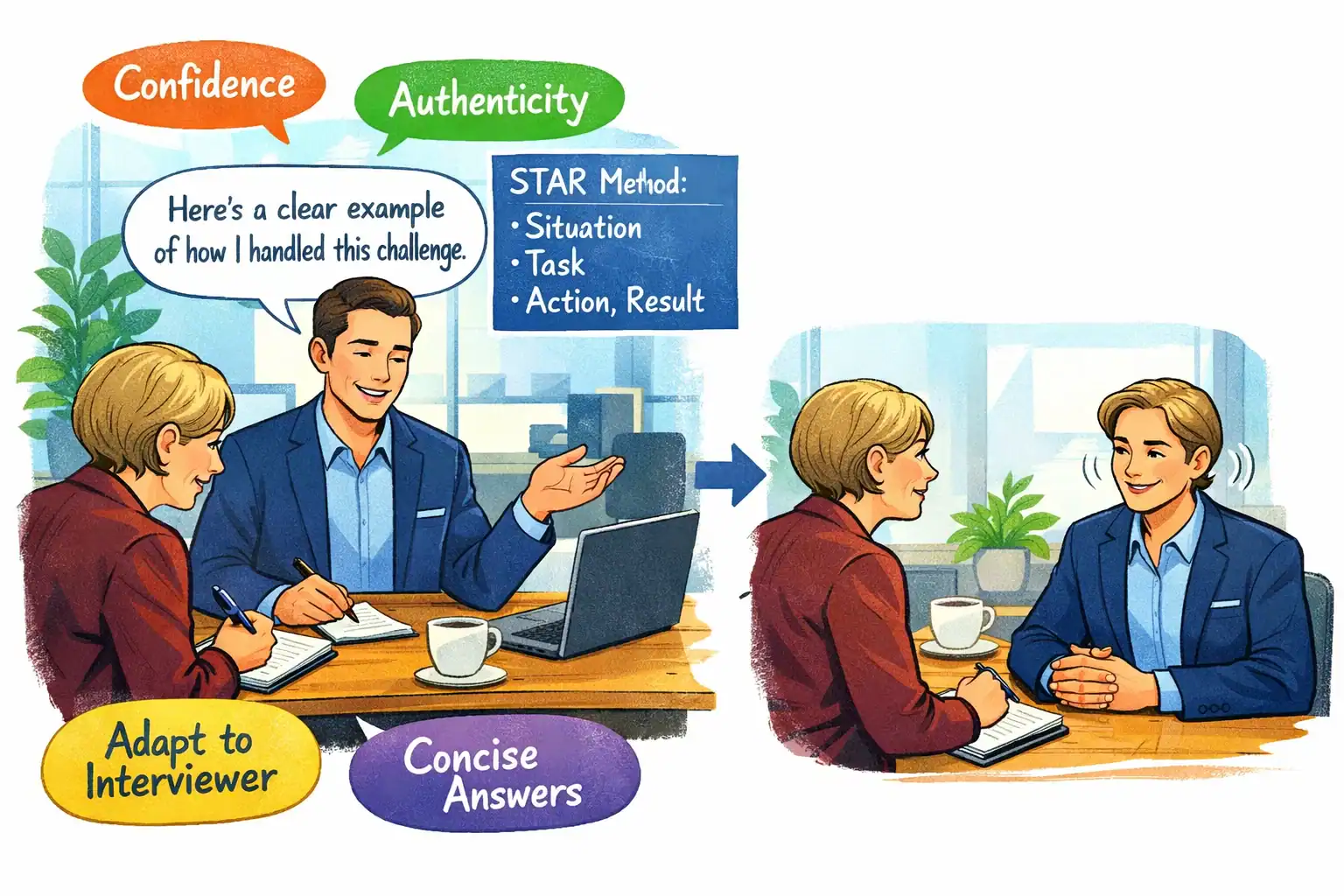
Confidence is clarity. If you speak in short points, you sound confident even when you are nervous.
Adapt to the Interviewer’s Reaction
If they lean in and ask for more, expand your example using STAR Method (Situation, Task, Action, Result) (STAR). If they nod and move on, stop.
This avoids rambling and keeps your answer sharp.
Example Questions & Answers
These are common versions of the same interview check. Your structure stays the same.
How does your background and experience prepare you for this role?
Answer with 2 skills + proof:
“My background fits because i’ve done similar tasks and i’ve delivered results. For example, i improved reporting accuracy and reduced follow-up work by tightening my checks and communication.”
What can you bring to this role?
Bring value + work style:
“I bring strong communication, reliable delivery, and a practical problem-solving mindset. I can take ownership of core tasks and keep stakeholders updated.”
How do you believe you can add value to our organisation?
Name impact:
“I add value by improving speed, quality, or customer experience. I do that by staying organised, tracking priorities, and solving problems early.”
Why are you a good fit for this role?
Fit = skills + team style:
“I’m a good fit because my skills match the job needs and my work style suits a team environment. I communicate clearly, take feedback well, and stay consistent under pressure.”
Why are you the ideal person for this position?
Be careful. Do not attack other candidates. Compare yourself to the role, not people:
“I’m ideal because i match your key requirements and i can prove performance. I also bring a steady, reliable work style that makes teams easier to run.”
How will your skills and experience benefit our team?
Explain how the team wins:
“My skills reduce workload for others, improve outcomes, and keep things organised. That helps the team hit deadlines and deliver better service.”
Answer Examples
Now let’s get to the part you came for: why should we hire you answer examples that sound natural in Australia.
‘Why should we hire you?’ Example Answers
1) Professional (general)
“You should hire me because i match the role requirements and i can show results. I’ve delivered on deadlines, improved processes, and kept communication clear with stakeholders. I’ll bring reliable delivery, a proactive problem-solving mindset, and strong teamwork from day one.”
2) Customer service / retail
“You should hire me because i handle customers well, i stay calm under pressure, and i’m reliable on shifts. I’ve worked in busy environments, resolved issues quickly, and kept service standards consistent. I’ll support the team and keep the customer experience strong.”
3) Admin / office support
“You should hire me because i’m organised, accurate, and easy to work with. I keep tasks moving, i follow process, and i communicate clearly. I’ll help the team by reducing errors, tracking priorities, and keeping work consistent.”
4) Accounting / payroll (fits Accounting CV, Financial Accountant, Payroll Officer)
“You should hire me because i’m accurate, deadline-focused, and comfortable with compliance work. I’ve handled reconciliations, reporting, and process checks with low error rates. I’ll bring strong attention to detail, clear communication, and steady delivery during busy periods.”
5) Fresher / graduate
“You should hire me because i’m job-ready, i learn fast, and i take feedback well. I’ve built transferable skills through study, projects, and part-time work. I’ll bring energy, clear communication, and consistent effort, and i’ll grow quickly once i’m in the role.”
These cover why should we hire you example answers, why should we hire you examples, and why should we hire you best answer patterns without sounding scripted.
‘Why should we hire you?’ Examples for Different Industries and Job Types
Below are industry-focused examples. Each one can be shortened into why should we hire you 3 points or expanded into why should we hire you 5 points.
Retail / casual (availability matters)
“I’m a strong fit because i’ve worked fast-paced shifts, i’m reliable, and i communicate clearly. I can handle customers, follow process, and support the team during peak periods. I can start quickly and i’m flexible with roster needs.”
Sales (proof matters)
“I’m a strong fit because i can build pipeline, manage relationships, and close with discipline. I track activity, improve conversion, and keep stakeholder communication clear. I’ll bring a results-oriented approach and steady execution.”
Accounting / finance (accuracy matters)
“I’m a strong fit because i deliver accurate work on deadlines and i understand compliance. I’ve improved reporting quality by tightening checks and standardising processes. I’ll bring consistent delivery and clear communication during close cycles.”
Engineering / technical (risk control matters)
“I’m a strong fit because i deliver safe, compliant work and i work well across teams. I’ve supported projects through planning, coordination, and quality checks. I’ll bring clear communication, steady delivery, and strong problem-solving skills.”
Good Example Answers for ‘Why do you want this job?’
Here are answers that match Australian expectations and connect to value.
Showcase genuine enthusiasm with context
“I want this job because the role matches my skills and the day-to-day work suits how i operate. I like clear targets, teamwork, and practical problem-solving. I can see where i’ll add value quickly.”
That also fits:
-
why do you want this job answer
-
why do you want to work for us
-
why would you work for us
-
why are you interested in this role
-
why are you interested in this position
-
how to answer why are you interested in this role
-
what appeals to you about this role
-
what appeals to you about this position
-
what motivated you to apply for this position
-
why did you apply for this position
Showcase your strategic value proposition
“I want this role because it’s a strong match for my background, and the company focus fits my work style. I can contribute through reliable delivery, clear communication, and continuous improvement. I’m ready to take ownership of core tasks and support the team’s outcomes.”
Summary
The question “Why should we hire you?” is one of the most important interview moments in the Australian job market. Employers use it to confirm whether a candidate can deliver results, work well with others, and add value quickly. Strong answers are short, specific, and grounded in real examples rather than personal needs or vague strengths. By preparing a clear structure, tailoring your response to the role, and backing it with evidence from your resume or experience, you can answer confidently—whether you are a fresher, career changer, or experienced professional.
FAQs
What is the Recommended Length for a Resumé?
For most Australian jobs, the recommended length is 1–2 pages.
If you are a student or early-career, keep it to one page. If you have relevant experience, two pages is normal.
How Does Professional Experience Impact Resumé Length?
More relevant experience supports a longer resumé. Keep older roles short. Put detail into roles that match the job.
Your interview answer should follow the same logic. Use one strong example from recent work.
Are There Industry-Specific Guidelines for Resumé Length?
Yes. Some roles need more detail:
engineering
healthcare
regulated roles
Some roles work best with one page:
retail
casual roles
entry-level roles
How Should I Tailor My Resumé Length Based on the Job I’m Applying For?
Tailor by cutting anything that does not match the job ad. Match keywords, tools, and outcomes.
Use the same method for interviews. Mirror the role language. Use proof. Keep it short.
Is There an Ideal Resumé Length for Applicant Tracking Systems (ATS)?
ATS does not care about page count. ATS cares about readable structure and relevant keywords.
Use standard headings and simple formatting. Use Australian job terms where they fit.
How Can Recent Graduates Optimise Their Resumé Length?
Use a one-page structure. Add projects, volunteering, and part-time work. Add outcomes and numbers where possible.
This makes it easier to answer why should we hire you answer as a fresher with proof.
In What Cases Should a CV Be Used Instead of a Resumé?
Use a CV for academic, research, and publication-heavy roles. A CV can be longer and more detailed.
Author Information
Anny Kuratulain | Career Development Expert
Anny Kuratulain is a seasoned professional with over 9 years of experience in social media strategy, freelance coaching, and resume optimization. Specializing in helping professionals in various fields, Anny provides expert guidance on crafting resumes that stand out to hiring managers and Applicant Tracking Systems (ATS). Anny’s insights focus on empowering job seekers to highlight their key strengths, tailor resumes to job descriptions, and land the jobs they desire.
